
understanding the pros and cons of flexible and solid wedge gate valves
understanding the pros and cons of flexible and solid wedge gate valves
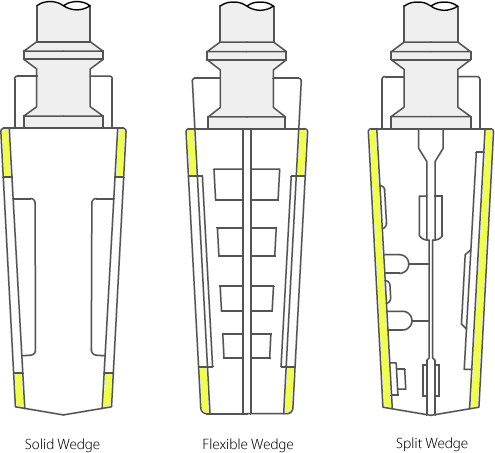
Flexible wedge gate valves are ideal for pipes that are not perfectly aligned and can adapt well to temperature changes. However, flexible wedge gate valves may become loose over time and often require more maintenance and repairs. In contrast, solid wedge designs, such as those found in a Cast Steel Gate Valve, China Gate Valve Supplier, or API602 Gate Valve, Forged Steel Gate Valve, offer greater strength and durability. These types of valves are best suited for systems that demand long-lasting performance.
Selecting the right valve—whether it’s flexible wedge gate valves, a Cast Steel Gate Valve from a China Gate Valve Supplier, or an API602 Gate Valve, Forged Steel Gate Valve—is crucial because:
- O type of fluid, pressure, and temperature fluctuations all impact valve performance.
- Durability, ease of maintenance, and overall cost are key factors in long-term efficiency.
Making the right valve choice ensures system safety, optimal operation, and cost savings.
Key Takeaways
- Flexible wedge gate valves can bend when it gets hot or cold. They keep a tight seal even when things change. This makes them good for systems with heat and pressure changes.
- Solid wedge gate valves are strong and simple. They work best when things stay the same. They do not cost much at first.
- You must pick the right valve for your system. Think about pressure, temperature, and what fluid you use. This helps keep things safe and working well. It also helps the valve last longer.
- Flexible wedge valves do not need much fixing when things change. But they cost more money. Solid wedge valves need more care but are cheaper at first.
- Always choose valves that match your system. Make sure they follow safety rules. Pick ones that are easy to take care of. This helps you avoid big repairs and keeps your system working well.
Overview
Wedge Gate Valves Explained
Wedge gate valves help control how liquids and gases move in pipes. These valves have a wedge-shaped disc that can stop or let things flow. The wedge shape helps make a tight seal. This keeps leaks from happening and makes sure the valve shuts off well. Valve makers sort wedge gate valves in different ways. The table below shows some common ways to group them:
| Classification Criteria | Types/Examples |
|---|---|
| Disk Type | Solid taper wedge, Flexible wedge, Split wedge |
| Body Bonnet Joint | Screwed bonnet, Bolted bonnet, Welded bonnet, Pressure-seal bonnet |
| Stem Movement | Rising stem (OS & Y type), Non-rising stem |
Engineers know about several main types of wedge gate valves:
- Solid Wedge Gate Valve: Has one solid wedge. It seals well and lasts long. It works best in places with high pressure and heat.
- Flexible Wedge Gate Valve: Has two wedge pieces with a hinge. It can bend and keep a tight seal when things change.
- Split Wedge Gate Valve: Has two parts that come apart. This helps lower friction and wear when used.
- Resilient Wedge Gate Valve: Has a wedge covered in rubber. This helps it seal better and keeps it from rusting.
Each type is good for different jobs.
Why Valve Type Matters
Picking the right wedge gate valve is important for how well a system works. It also affects how safe and reliable the system is. The valve type helps decide how well the system controls flow and handles pressure. It also helps keep a tight seal. For example, solid wedge valves are best for steady, high-pressure places. Flexible wedge valves are better when pipes move or get hot and cold. The right valve can help you control things better, fix less, and save money. In water, oil, and gas pipes, the right valve helps things run well for a long time. Picking the right valve also helps meet industry rules. This keeps the system safe and working right.
Flexible Wedge Gate Valves

China Flexible Wedge Gate Valves ,Flexible Wedge Gate Valves Supplier
Características de design
Flexible wedge gate valves have a special design. They use a gate that can bend a little or has a hinge. This lets the valve change shape when the system gets hotter or colder. The flexible disc can move to keep a good seal. This helps stop leaks and keeps the valve from getting stuck. These valves are easier to open and close than solid wedge valves. You do not need to use as much force. The flexible wedge design also helps stop leaks. It means you do not have to fix them as often.
Note: The flexible disc helps stop problems from heat making things bigger. This is why these valves work well when temperatures change a lot.
Typical Uses
Engineers pick flexible wedge gate valves for steam systems. These valves work well where heat and pressure change fast. Power plants and heating systems use these valves a lot. Industrial steam lines also use them because they are strong. They can handle hard jobs and keep working. Many industries like them because they can adjust to changes.
Pros of Flexible Wedge Gate Valves
Flexible wedge gate valves have many good points:
- The flexible disc can fit even if the seat moves. This helps stop leaks.
- These valves do not get stuck from heat as much.
- People find them easy to open and close, even if pressure changes.
- The design means you do not have to fix them as much. They last longer.
Here is a table that shows the main good things:
| Benefit | Descrição |
|---|---|
| Leak Tightness | Keeps a strong seal even if the seat moves |
| Thermal Expansion Adaptation | Stops jamming or sticking from heat |
| Lower Maintenance | Needs fewer repairs over time |
| Ease of Operation | Needs less force to open and close |
Cons of Flexible Wedge Gate Valves
Even though they are good, flexible wedge gate valves have some bad points:
- O disk can hold fluid inside. This can cause rust and make the valve weak.
- These valves can be slow to use. You have to turn them many times to open or close.
- Fixing or working on the valve seats is hard when the valve is in place.
- Like other gate valves, they can still have problems with heat or pressure making them stick.
Caution: Check these valves often to find rust or damage early.
Solid Wedge Gate Valves

800LB Solid Wedge Gate Valve Factory,Solid Wedge Gate Valve Manufacture
Características de design
Solid wedge gate valves have one solid piece for the gate. This piece fits tightly in the valve seat. The design does not let the gate bend or flex. The solid wedge makes a strong seal if temperature and pressure stay steady. But, if temperature changes fast, the valve can stick. The table below shows how solid wedge and flexible wedge gate valves compare:
| Aspect | Solid Wedge Gate Valve | Flexible Wedge Gate Valve |
|---|---|---|
| Construção | One-piece solid gate, precisely machined for tight fit | One-piece gate with ring-shaped groove or hollowed areas allowing flexing |
| Sealing Performance | Tight seal under stable conditions; prone to thermal binding | Improved sealing; resists thermal binding and adapts to seat deflections |
| Adaptability | Rigid, can deform or bind with temperature changes | Flexible, adapts to thermal and pressure changes |
| Application Suitability | Best for stable, low-pressure, low-temperature systems | Best for high-pressure, high-temperature, dynamic systems |
| Durability | Sensitive to thermal stress | Durable under fluctuating conditions |
| Cost | More economical | More expensive |
Typical Uses
Solid wedge gate valves are used in many industries. They are found in oil, gas, water, and steam systems. Power plants and petrochemical plants use them because they seal well and are simple. These valves work best where pressure and temperature do not change much. Their shape makes them easy to install. Workers do not need to worry about which way the flow goes. When open, these valves let fluids move easily. This lowers turbulence and keeps the system safe.
- Oil and gas pipelines
- Water supply systems
- Steam lines in power plants
- Petrochemical processing
- Nuclear applications with stable conditions
Pros of Solid Wedge Gate Valves
Solid wedge gate valves have many good points:
- The simple, one-piece design makes them reliable.
- They seal tightly in steady conditions and stop leaks.
- They cost less than flexible wedge valves.
- Their shape makes them easy to install.
- When open, fluids flow with little resistance.
- They open and close slowly, which lowers water hammer risk.
- They last a long time in low-pressure, low-temperature places.
Tip: Use solid wedge gate valves where conditions do not change much for the best results.
Cons of Solid Wedge Gate Valves
These valves also have some problems:
- The rigid gate can jam if temperature or pressure changes fast.
- They do not work well in high-temperature or high-pressure systems.
- If left partly open, vibration can cause damage.
- Throttling can wear down the gate over time.
- Maintenance is hard because the parts must fit just right.
- Problems can include leaks, hard handwheel turning, and stem wear.
- You need to clean, oil, and check these valves often to stop issues.
Note: Always keep these valves fully open or fully closed. This helps avoid damage and makes them last longer.
Comparison
Sealing and Performance
Sealing is a big difference between flexible wedge gate valves and solid wedge gate valves. Flexible wedge designs have a grooved or cut wedge. This lets them move with the seat and handle heat changes. The flexible wedge keeps a tight seal even if pipes get bigger or smaller. Solid wedge valves use one hard gate. They seal well when things stay the same but can have trouble if temperatures change fast.
Flexible wedge gate valves do not stick as much after cooling in hot systems. They are easier to use because you do not need much force. Solid wedge valves are strong but can jam if temperatures change quickly. Both types can seal in both directions. But flexible wedge valves work better with pressure and temperature changes.
| Feature/Aspect | Flexible Wedge Gate Valve | Solid Wedge Gate Valve |
|---|---|---|
| Gate Construction | Grooved or cut wedge for flexibility | Single solid wedge |
| Sealing Mechanism | Maintains seal during thermal cycling | Best seal in stable conditions |
| Performance in High Temp | Resists sticking after cooling | May stick or bind |
| Operating Torque | Lower, easier to operate | Higher, requires more force |
Tip: If your system gets hot and cold a lot, flexible wedge gate valves seal better and work more smoothly.
Maintenance Needs
Maintenance is different for these two valve types. Flexible wedge gate valves often have special coatings like NBR or EPDM. These coatings stop rust and wear. This helps the valve last longer and need fewer repairs. Solid wedge gate valves use metal parts that touch each other. Over time, these metal parts can rust or wear out, especially in tough places. This makes the seal weaker and can cause leaks.
Flexible wedge gate valves usually need less fixing because they handle heat changes better. Solid wedge valves are strong but may need more care for rust, seat wear, and jamming. Both types can be fixed while still in the pipe. This helps save time in big systems.
| Aspect | Flexible Wedge Gate Valves | Solid Wedge Gate Valves |
|---|---|---|
| Construção | Flexible wedge, elastomer-coated | Solid metal wedge, metal-to-metal seating |
| Sealing and Maintenance | Tight seal, low maintenance, less exposed to corrosion | More frequent maintenance due to corrosion and abrasion |
| Durability Concerns | Can deform if over-tightened | Robust but sealing surfaces wear faster |
Note: Check and oil both valve types often. Flexible wedge designs usually need less service.
Cost Factors
Cost is important when picking a valve. Flexible wedge gate valves cost more than solid wedge gate valves. They cost more because their design is complex and they use special materials. For example, a 1-1/2 inch flexible wedge valve costs about $468.75. Bigger ones can cost over $3,000.
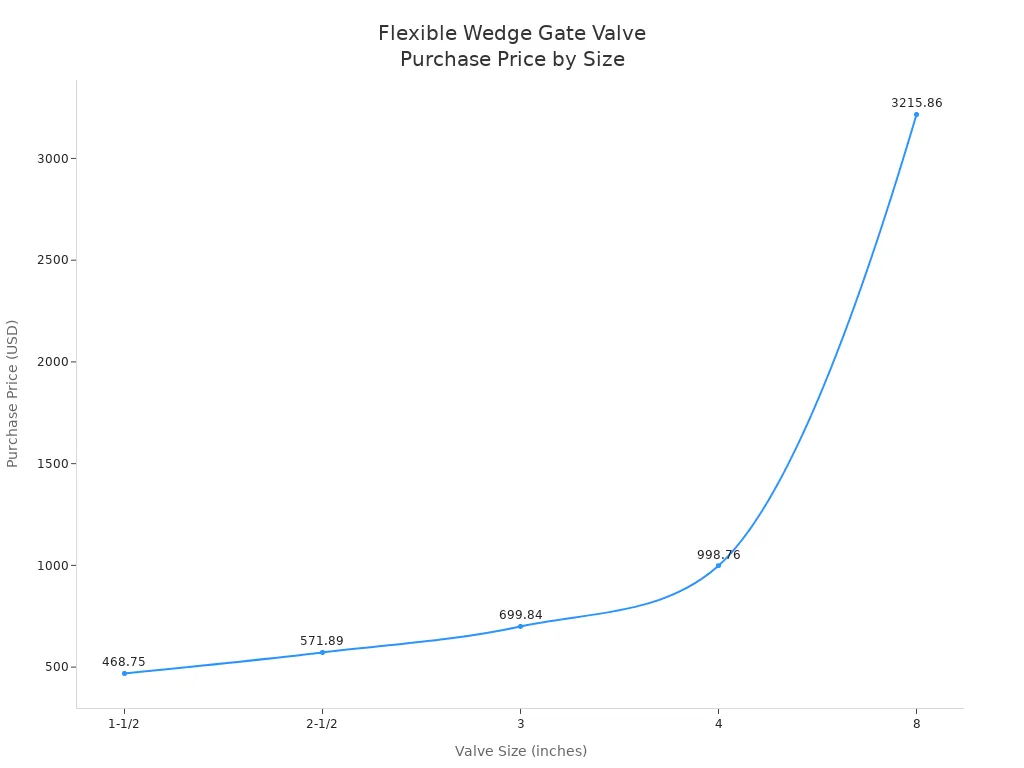
Solid wedge gate valves are simpler. This makes them cheaper to buy and put in. In factories, wedge gate valves cost from $150 to $2,000, depending on size and material. Solid wedge valves are picked because they cost less at first and are strong.
But, the cost over time can change. Flexible wedge gate valves may save money in the long run if the system gets hot and cold a lot. They need less fixing and last longer in these places. Solid wedge valves may cost more to keep up if used where heat changes a lot.
| Tipo de válvula | Size (inches) | Approximate Purchase Price (USD) |
|---|---|---|
| Flexible (Resilient) Wedge | 1-1/2 | $468.75 |
| Flexible (Resilient) Wedge | 2-1/2 | $571.89 |
| Flexible (Resilient) Wedge | 3 | $699.84 |
| Flexible (Resilient) Wedge | 4 | $998.76 |
| Flexible (Resilient) Wedge | 8 | $3,215.86 |
Note: Solid wedge valves are cheaper at first. But flexible wedge gate valves may save money later in tough jobs.
Application Suitability
Picking the right valve depends on what your system needs. Flexible wedge gate valves are best for systems that get hot and cold a lot, like HVAC and steam lines. Their design lets them move and handle changes. This makes them good for busy places. They also work well for low-pressure water, sewage, and natural gas.
Solid wedge gate valves are good for jobs where things stay the same. People use them in oil, gas, water, and steam systems with steady pressure and temperature. Their strong design handles stress well. But they may not work as well if things change fast.
Thermoplastic valves, like PVDF ones, fight rust and wear better than metal valves. For very harsh fluids, diaphragm or pinch valves may work better and need less fixing.
Key Differences:
- Flexible wedge gate valves are best for busy, hot, or high-pressure systems.
- Solid wedge gate valves are cheaper and work well in calm places.
- Flexible wedge designs do not stick as much and need less fixing.
- Solid wedge valves are strong and easy to put in.
Tip: Always pick the valve type that matches your system’s pressure, temperature, and fluid. This gives you the best results and keeps things safe.
Choosing the Right Valve
Key Considerations
Picking the right wedge gate valve takes careful thought. Engineers need to match the valve to the system’s pressure, temperature, and fluid. The table below shows how flexible and solid wedge gate valves are different in tough conditions:
| Factor | Flexible Wedge Gate Valve | Solid Wedge Gate Valve |
|---|---|---|
| Design | One-piece disk with perimeter cut for flexibility | Solid, simple, and strong disk |
| Thermal Expansion & Seat Misalignment | Flexes to prevent binding from thermal expansion and seat compression | Rigid; may bind if seats compress due to heat |
| Suitability for Steam/High Temp | Preferred for steam systems to prevent valve binding | Less suitable for steam; risk of binding |
| Strength & Durability | Flexibility may reduce strength; deeper cuts increase flexibility but lower strength | Stronger and simpler; handles turbulent flow and high pressure |
| Operational Concerns | Risk of water collection in body neck; possible rupture if not warmed properly | Fewer thermal-related concerns |
| Maintenance | Needs proper warming to avoid damage | Robust; fewer special procedures |
| Best Application | Systems with thermal expansion and seat misalignment, e.g., steam and high-temp lines | General high-pressure fluid systems |
Temperature and fluid type are also important when picking a valve. In chemical plants, flexible wedge valves can handle pipes that get bigger or smaller. They keep a good seal even if things get hotter or colder. Solid wedge gate valves seal well when things stay the same. But they might jam if the system changes shape or heats up fast. For fluids that can cause rust or wear, both types have good points. Flexible wedge valves work well when things change a lot. Solid wedge valves fight rust and wear in calm systems.
Tip: Always think about where the valve will be used. If things change a lot, flexible wedge designs work better. If things stay the same, solid wedge valves are a good choice.
Selection Tips
Engineers can use these tips to pick the best wedge gate valve:
- Match Valve Type to System Needs
- Use flexible wedge gate valves if temperature or pressure changes often, like in steam lines or chemical plants.
- Pick solid wedge gate valves for steady, high-pressure systems where temperature does not change much.
- Check Material and Coating
- Ductile iron is good for city water pipes because it is strong and fights rust.
- For drinking water, make sure the valve meets NSF 61 and AWWA rules.
- Seats made from EPDM or Nitrile seal better and resist chemicals.
- Consider Stem Type and Installation Space
- Rising stem valves are good for small or medium pipes and are easy to check.
- Non-rising stem valves fit big pipes or tight spaces.
- Size and Pressure Rating
- Pick the right size valve for how much fluid will flow.
- Make sure the valve’s pressure rating is high enough for your system.
- Plan for Maintenance
- Valves with removable or bolted bonnets are easier to fix.
- Choose valves you can fix without taking them out of the pipe.
- Application-Specific Guidance
- City water systems work well with single gate, rising stem wedge gate valves. These seal well and are easy to use.
- Chemical plants should use flexible wedge valves to handle heat and rust.
- For most high-pressure pipes, solid wedge gate valves are strong and easy to care for.
Common Mistakes to Avoid:
- Do not use wedge gate valves to control flow or at pipe ends. They work best fully open or closed.
- Do not forget to warm up flexible wedge gate valves in steam systems.
- Always check if the valve meets rules for drinking water or chemicals.
- Do not ignore the stem type or space needed for the valve. This can make fixing or using the valve harder.
- Do not pick a valve just because it is cheap. Think about how much it will cost to fix or replace later.
Note: Always pick valves that seal well, are easy to fix, and meet safety rules.
Picking the right wedge gate valve keeps the system safe and working well. The table below shows the main good and bad points:
| Tipo de válvula | Vantagens | Disadvantages |
|---|---|---|
| Solid Wedge | Strong, simple, works with many liquids | Not flexible, can get stuck |
| Cunha Flexível | Fits seats that are not lined up, seals well | Strength changes with how it is made |
Engineers need to choose the valve that fits the job. In water plants or oil and gas, flexible wedge gate valves seal better and can adjust more. Experts say to check what the project needs, how it will be used, and the rules before picking a valve.
Perguntas frequentes
What is the main difference between flexible and solid wedge gate valves?
Flexible wedge gate valves have a disc that can bend. This lets them deal with changes in temperature. Solid wedge gate valves have a stiff disc that does not bend. They work best when things stay the same.
Can you use wedge gate valves for throttling flow?
Engineers say not to use wedge gate valves for throttling. These valves should be either fully open or fully closed. Throttling can hurt the valve and make it not last as long.
How often should you maintain wedge gate valves?
You should check wedge gate valves often to keep them working. Most systems need a check every six months. Maintenance means cleaning, adding oil, and looking for leaks or damage.
Which industries use flexible wedge gate valves most often?
Power plants, chemical plants, and steam systems use flexible wedge gate valves a lot. These places need valves that can handle changes in heat and pressure.