
Understanding Knife Gate Valve: Complete Guide to Industrial Applications
Understanding Knife Gate Valve: Complete Guide to Industrial Applications
Knife gate valves play a critical role in industrial fluid handling systems, particularly where media contains suspended solids or high viscosity materials. These specialized valves provide reliable isolation in challenging applications across mining, pulp and paper, wastewater treatment, and chemical processing industries. This comprehensive guide explores their design, operation, selection criteria, and maintenance requirements to help engineers and maintenance professionals optimize valve performance and longevity.
Working Principle of Knife Gate Valves
Knife gate valves operate on a straightforward principle: a thin, sharp-edged gate moves perpendicular to the flow path to provide isolation. Unlike traditional gate valves, knife gate valves feature a sharpened leading edge that can cut through suspended solids and viscous media, preventing material buildup that could interfere with valve closure.
The operation follows these basic steps:
- When open, the gate is fully retracted from the flow path, allowing unrestricted media passage.
- During closure, the gate moves linearly downward through the valve body.
- The sharp edge cuts through any suspended solids or viscous materials in the flow path.
- The gate seats against the bottom seal, creating a tight shutoff.
- Upon opening, the gate retracts upward, clearing the flow path completely.

This simple yet effective design makes knife gate valves ideal for applications where traditional valves might struggle with clogging or incomplete closure due to solid particles. The linear motion requires less torque than rotary valves, and the full-bore opening minimizes pressure drop when the valve is open.
Design and Components of Knife Gate Valves
Understanding the key components of knife gate valves helps in proper selection and maintenance. Each component plays a vital role in the valve’s performance and longevity, especially in harsh service conditions.
Valve Body
The valve body houses all components and connects to the pipeline. Bodies can be cast (for standard applications) or fabricated (for custom requirements). Common materials include:
- Cast iron (ASTM A126)
- Ductile iron (ASTM A536)
- Carbon steel (ASTM A216)
- Stainless steel (304, 316, 317)
- Special alloys for corrosive service
Gate and Stem
The gate provides the shutoff mechanism. It features a beveled edge for cutting through media and typically includes:
- Stainless steel construction (304, 316, 317)
- Hardened edges for abrasive service
- Polished surface for smooth operation
- Connection to the stem for actuation
The stem transfers force from the actuator to the gate and may be rising or non-rising design.
Seats and Seals
Seats provide the sealing interface with the gate. Options include:
- Metal seats for high temperature
- Resilient seats (EPDM, Viton, NBR)
- Urethane for abrasive slurries
- PTFE for chemical resistance
Packing seals the stem area to prevent leakage and may include live-loading for maintenance-free operation.
Actuators
Actuators provide the force to operate the valve. Common types include:
- Manual handwheel or lever
- Pneumatic cylinders (single or double acting)
- Electric actuators
- Hydraulic cylinders for high force applications
- Bevel gear operators for large valves
Chest and Packing
The chest houses the packing that seals around the gate. Features include:
- Adjustable packing gland
- Multiple packing rings
- Various packing materials (PTFE, graphite, synthetic fibers)
- Optional purge connections for flushing
- Live-loaded packing systems
Connection Types
Knife gate valves connect to piping systems via:
- Wafer style (clamped between flanges)
- Lugged design (bolted to one or both flanges)
- Flanged ends (integral flanges)
- Mechanical joint connections
- Custom connections for special applications
Types of Knife Gate Valves
Knife gate valves come in various configurations to address specific application requirements. Understanding these variations helps in selecting the optimal valve for your service conditions.
By Flow Direction Capability
Unidirectional Knife Gate Valves
- Designed for flow in one direction only
- Typically more economical
- Simpler seat design
- Suitable for most standard applications
- Often used in wastewater and general industrial service
Bidirectional Knife Gate Valves
- Provides tight shutoff in both flow directions
- More complex seat design
- Higher cost than unidirectional
- Used where flow direction may reverse
- Common in process applications with potential backflow
By Port Design
Full Port (Through-Conduit)
- No obstruction in flow path when open
- Minimal pressure drop
- Ideal for slurries and high solid content
- Allows passage of pipeline pigs and scrapers
- Prevents material buildup in valve body
Porto reduzido
- Smaller flow area than pipe diameter
- Higher pressure drop
- More compact design
- Often used where space is limited
- Lower cost in some configurations
By Seat Material
Resilient Seated
- Elastomer or polymer seats
- Excellent sealing capability
- Good for general service applications
- Temperature limitations (typically under 400°F)
- Available in various materials for chemical compatibility
Metal assentado
- All-metal construction
- Suitable for high temperatures
- More durable in abrasive applications
- May not provide bubble-tight shutoff
- Used in severe service conditions
By Actuation Method
- Manual: Handwheel or lever operated for infrequent operation or smaller valves
- Pneumatic: Air-operated cylinders for remote or automated operation
- Electric: Motor-driven actuators with position feedback and control options
- Hydraulic: Fluid-powered actuators for high force requirements
Need Help Selecting the Right Knife Gate Valve?
Our valve experts can help you navigate the various types and configurations to find the optimal solution for your specific application requirements.
Key Features and Advantages of Knife Gate Valves
Knife gate valves offer several distinct advantages that make them the preferred choice for challenging applications involving slurries, viscous media, and solids-laden fluids.
Superior Handling of Solids
The sharp, knife-like gate effectively cuts through suspended solids and fibrous materials that would jam conventional valves. This makes knife gate valves ideal for:
- Mining slurries with high mineral content
- Pulp and paper stock with fibrous materials
- Wastewater with biosolids and debris
- Food processing with pulp and particulates
Space-Efficient Design
The compact face-to-face dimension makes knife gate valves ideal for installations with limited space:
- Significantly shorter than conventional gate valves
- Reduced weight compared to other valve types
- Smaller actuators due to linear operation
- Easier to accommodate in retrofit applications
- Reduced structural support requirements
Minimal Flow Restriction
When open, full-port knife gate valves provide an unobstructed flow path, offering:
- Reduced pressure drop across the valve
- Lower energy consumption for pumping
- Minimized turbulence and wear
- Ability to pass pipeline cleaning devices
- Prevention of material buildup within the valve
Simple Maintenance
The straightforward design facilitates easier maintenance:
- Accessible packing for adjustment or replacement
- Fewer moving parts than other valve types
- In-line replaceable seats in many designs
- Visual confirmation of position
- Straightforward troubleshooting
Cost Effectiveness
Knife gate valves typically offer economic advantages:
- Lower initial cost than comparable valves
- Reduced maintenance expenses
- Longer service life in slurry applications
- Lower actuation costs due to linear operation
- Reduced downtime in challenging services
Versatility Across Applications
Modern knife gate valves are engineered for diverse applications:
- Pressure ratings from vacuum to 740 psi
- Temperatures from cryogenic to 1000°F
- Sizes from 2″ to 144″ and larger
- Materials for highly corrosive environments
- Specialized designs for specific industries
Industrial Applications of Knife Gate Valves
Knife gate valves serve critical roles across numerous industries, particularly where challenging media conditions exist. Their unique capabilities make them ideal for specific applications within each sector.
Mining & Mineral Processing
- Tailings Management: Isolation of abrasive tailings slurries
- Concentrator Plants: Control of mineral slurries with high solids content
- Leaching Circuits: Handling of corrosive chemical slurries
- Thickener Underflow: Control of high-density settled solids
- Filter Press Feeds: Regulation of dewatering processes
Pulp & Paper Industry
- Stock Preparation: Control of fibrous pulp slurries
- Black Liquor Systems: Handling of corrosive recovery chemicals
- White Liquor Systems: Control of caustic process fluids
- Bleach Plant: Isolation in corrosive chemical environments
- Effluent Treatment: Management of process waste streams
Wastewater Treatment
- Primary Treatment: Isolation of raw sewage and grit
- Sludge Processing: Control of biosolids and thickened sludge
- Digester Feeds: Regulation of organic waste streams
- Dewatering Equipment: Isolation for filter presses and centrifuges
- Effluent Control: Management of treated water discharge
Power Generation
- Ash Handling: Control of abrasive fly ash and bottom ash slurries
- FGD Systems: Management of limestone slurry and gypsum byproducts
- Coal Slurry: Regulation of pulverized coal and water mixtures
- Cooling Water: Isolation in large diameter water systems
- Waste Treatment: Control of process effluents
Chemical Processing
- Reactor Isolation: Control of process chemicals and catalysts
- Filter Feed: Regulation of slurries to filtration equipment
- Crystallizer Systems: Management of crystal slurries
- Polymer Processing: Control of high-viscosity materials
- Waste Treatment: Isolation of chemical waste streams
Food & Beverage
- Fruit Processing: Control of pulp and solids-laden juices
- Vegetable Preparation: Management of wash water and waste
- Brewing: Isolation of grain mash and spent grains
- Sugar Processing: Control of viscous syrups and crystalline slurries
- Waste Management: Regulation of organic waste streams
Find the Optimal Valve for Your Industry
Our application engineers specialize in industry-specific valve solutions that maximize reliability and performance while minimizing maintenance and downtime.
Selection Criteria for Knife Gate Valves
Choosing the right knife gate valve requires careful consideration of multiple factors to ensure optimal performance and longevity in your specific application.
| Selection Factor | Considerations | Impact on Selection |
| Media Characteristics | Solids content, abrasiveness, corrosiveness, viscosity, temperature | Determines body material, seat type, and gate design |
| Pressure Requirements | Maximum operating pressure, vacuum service, pressure spikes | Influences pressure class, body design, and actuator sizing |
| Temperature Range | Minimum and maximum process temperatures, ambient conditions | Affects seat material selection and packing type |
| Flow Characteristics | Flow rate, velocity, pressure drop requirements, bi-directional needs | Determines port size and valve type (uni/bi-directional) |
| Actuation Requirements | Manual vs. automated, control system integration, fail position | Guides actuator type and accessories selection |
| Installation Constraints | Space limitations, mounting orientation, accessibility | Influences body style and connection type |
| Maintenance Considerations | Frequency of service, spare parts availability, in-line serviceability | Affects overall design and features selection |
Material Selection Guide
Selecting appropriate materials for válvula de guilhotina components is critical for performance and longevity in specific service conditions:
Body Materials
- Cast Iron: Economical choice for non-corrosive applications below 450°F
- Ductile Iron: Higher pressure ratings and impact resistance than cast iron
- Carbon Steel: Good for moderate temperatures and pressures
- 304 Stainless Steel: General corrosion resistance for many chemicals
- 316 Stainless Steel: Enhanced corrosion resistance, especially to chlorides
- Duplex Stainless: Higher strength and corrosion resistance than 316
- Alloy 20: Excellent for sulfuric acid applications
Seat/Sleeve Materials
- EPDM: Good for water, steam, and alkaline solutions to 300°F
- Viton/FKM: Excellent chemical resistance, temperatures to 400°F
- Nitrile/Buna-N: Good for petroleum applications to 250°F
- Natural Rubber: Excellent for abrasive slurries to 180°F
- Urethane: Superior abrasion resistance for mining applications
- PTFE: Outstanding chemical resistance to 450°F
- Metal (various alloys): For high temperature applications to 1000°F
Gate Materials
- 304 Stainless Steel: Standard for general service
- 316 Stainless Steel: Enhanced corrosion resistance
- 17-4PH Stainless: Higher strength for severe service
- Stellite Facing: Added for extreme abrasion resistance
- Hardened Steel: For cutting applications
- Duplex Stainless: Combined strength and corrosion resistance
- Hastelloy: For highly corrosive environments
Need Help With Valve Selection?
Our valve experts can guide you through the selection process to ensure you get the right valve for your specific application requirements.
Installation and Maintenance Best Practices
Proper installation and regular maintenance are essential for maximizing the service life and performance of knife gate valves, particularly in challenging applications.
Installation Guidelines
- Orientation: Install with the stem vertical and actuator above the valve when possible to prevent media buildup in the bonnet area.
- Support: Provide adequate support for the valve and actuator to prevent pipeline stress.
- Clearance: Ensure sufficient clearance for gate movement and maintenance access.
- Alignment: Properly align flanges to prevent leakage and uneven gate wear.
- Bolting: Use proper torque sequences and values when tightening flange bolts.
- Flow Direction: For unidirectional valves, verify correct installation relative to flow direction.
- Actuation: Properly connect and adjust actuators according to manufacturer guidelines.
Maintenance Procedures
- Regular Inspection: Periodically check for leakage around the stem and body.
- Packing Adjustment: Tighten packing gland bolts evenly to eliminate stem leakage without over-compression.
- Lubrication: Apply appropriate lubricant to stem and moving components per manufacturer recommendations.
- Cycling: Regularly operate infrequently used valves to prevent seizing.
- Cleaning: Remove buildup from gate and seat areas during scheduled maintenance.
- Seat/Sleeve Replacement: Replace worn elastomer components before leakage occurs.
- Gate Inspection: Check for wear, corrosion, or damage to the gate edge.
Maintenance Interval Recommendations
The following maintenance intervals serve as general guidelines. Adjust based on your specific operating conditions and valve performance:
Light Duty Applications
- Visual inspection: Quarterly
- Packing adjustment: As needed
- Full maintenance: Annually
- Seat replacement: Every 3-5 years
Standard Service
- Visual inspection: Monthly
- Packing adjustment: Quarterly
- Full maintenance: Semi-annually
- Seat replacement: Every 1-3 years
Severe Service
- Visual inspection: Weekly
- Packing adjustment: Monthly
- Full maintenance: Quarterly
- Seat replacement: Every 6-12 months
Common Issues and Troubleshooting
Even with proper selection and maintenance, knife gate valves may encounter operational issues. Understanding common problems and their solutions helps minimize downtime and extend valve life.
Seat Leakage
Symptoms: Media passing through the valve when fully closed, visible leakage from valve body.
Possible Causes:
- Worn or damaged seat/sleeve material
- Foreign material preventing complete closure
- Insufficient actuator force
- Misalignment of gate and seat
- Chemical attack of seat material
Solutions:
- Replace seat or sleeve components
- Clean gate and seat surfaces
- Adjust or upgrade actuator
- Check for proper valve alignment
- Verify material compatibility with process media
Stem Leakage
Symptoms: Media leaking around valve stem or packing area.
Possible Causes:
- Loose or worn packing
- Improper packing installation
- Damaged stem surface
- Chemical attack of packing material
- Excessive system pressure
Solutions:
- Adjust packing gland evenly
- Replace packing with correct type
- Inspect and replace damaged stem
- Verify packing material compatibility
- Check system pressure against valve rating
Difficult Operation
Symptoms: Excessive force required to operate valve, jerky or inconsistent movement.
Possible Causes:
- Over-tightened packing
- Material buildup on gate or guides
- Bent or damaged stem
- Corrosion or scaling
- Insufficient actuator sizing
Solutions:
- Adjust packing to proper compression
- Clean gate and guide surfaces
- Replace damaged components
- Apply appropriate lubricant
- Upgrade actuator if necessary
Premature Wear
Symptoms: Rapid deterioration of valve components, frequent maintenance requirements.
Possible Causes:
- Improper valve selection for application
- Excessive media velocity or turbulence
- Abrasive particles in media
- Chemical attack of components
- Cavitation or flashing
Solutions:
- Review valve specification against service conditions
- Upgrade to more durable materials
- Consider specialized coatings or hardfacing
- Modify system to reduce velocity or turbulence
- Implement more frequent maintenance schedule
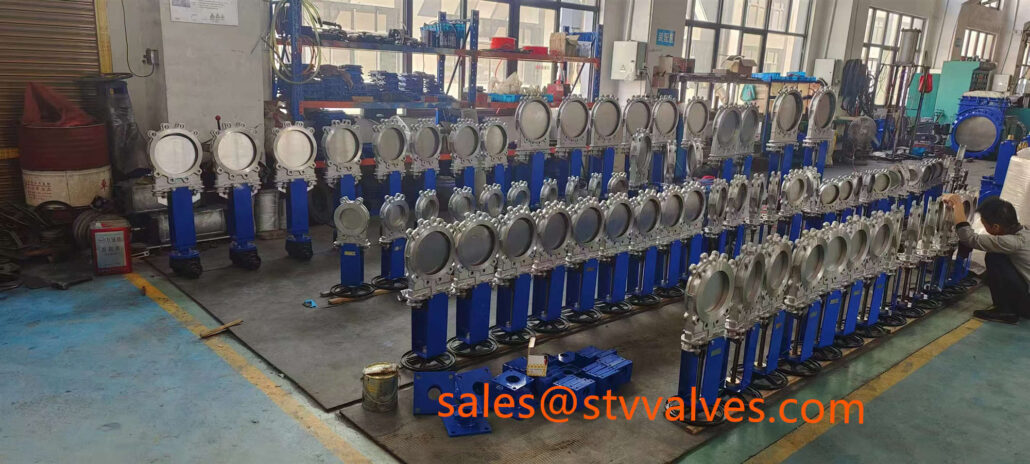
China SS wafer knife gate valve
Experiencing Valve Issues?
Our technical support team can help diagnose problems and recommend solutions to extend valve life and improve performance.
Contact Technical Support
Conclusão
Knife gate valves play a critical role in challenging industrial applications where conventional valves would fail. Their unique design enables reliable isolation of slurries, viscous media, and solids-laden fluids across mining, pulp and paper, wastewater treatment, power generation, and chemical processing industries.
Selecting the right knife gate valve requires careful consideration of media characteristics, pressure and temperature requirements, flow conditions, and installation constraints. Proper material selection for body, gate, and seat components is essential for maximizing valve life and performance in specific applications.
Following installation and maintenance best practices significantly extends valve service life and reduces total cost of ownership. Regular inspection, proper packing adjustment, and timely component replacement prevent unexpected failures and minimize downtime.
As industrial processes continue to demand higher reliability and efficiency, knife gate valve technology continues to evolve with improved materials, enhanced sealing designs, and advanced actuation options. Partnering with valve experts ensures optimal selection and application of these specialized valves for your specific requirements.