Lesen Sie die Nachrichten der STV Valve Company und erhalten Sie umfassendere Informationen über das Unternehmen, die neuesten Ventile und den Fortschritt der Ventilindustrie
You can find gate valves in many industries. Experts sort these valves into two main types of gate valves: parallel and wedge-shaped. Each type has its own special features. Wedge gate valves have angled sealing surfaces, which helps stop the valve from sticking when it gets hot. These types of gate valves are used in about 15% of all industrial valve jobs around the world.
Key Takeaways
Learn about the two main types of gate valves: parallel and wedge. Each type has special features for different uses.
Pick parallel gate valves for systems with solids or rough stuff. They seal well when pressure is low. They also work well in high heat.
Use wedge gate valves for clean fluids and high pressure. Their shape helps them seal tightly. This makes them good for important jobs.
Types of Gate Valves
type of gate valve
There are two main types of gate valves in factories. These are parallel gate valves and wedge gate valves. Each type has special features and smaller groups. Knowing how each type works helps you pick the right one.
Parallel Gate Valve
Parallel gate valves have a flat gate that slides between two seats. These valves are used in pipes that carry solids or rough materials. The seal in a parallel gate valve depends on fluid pressure or a force that pushes the gate. This design seals well both ways and helps stop the valve from sticking when it gets hot or cold.
Wedge gate valves have a gate with slanted sides that fit tightly between seats. These valves are used where strong sealing and high pressure are needed. The wedge shape helps the gate press hard against the seats for a tight seal. This design works best with clean fluids because dirt can hurt the seal.
Wedge gate valves come in three main kinds. The table below shows how each kind works:
Subtype
Design Characteristics
Functionality
Solid Wedge
Hard and does not bend. Can get stuck if the pipe gets hot or stressed.
Used in bronze, cast iron, and small carbon steel valves. May stick when temperatures change.
Flexible Wedge
Has a groove to bend a little. Handles changes in heat and pipe stress.
Most common type. Works with small flaws in the seats.
Split Wedge
Made of two pieces that fit together. Stops jamming from heat.
Used in stainless steel and strong alloy valves. Can jam if dirt gets between the pieces.
Wedge gate valves are made from cast steel and forged steel. Cast steel is strong and resists rust. Forged steel is even stronger and lasts longer, so it is good for high pressure. These materials help the valve work well in tough places.
Wedge gate valves have limits for pressure and heat. The pressure limit goes down when the temperature goes up. Flanged wedge gate valves connect tightly. Carbon steel wedge gate valves work well at high pressure and low heat. Cast steel wedge gate valves work in high pressure and high heat, but you must stay within the limits.
Tip: Wedge gate valves are good for general use and medium to high pressure. Parallel gate valves are best for long pipes, high heat, and systems that get hot and cold.
Each type of gate valve has its own good points. Pick the gate valve that fits your system best.
Features and Uses
Features and Uses gate valve
Parallel Gate Valve Features
A parallel gate valve has a flat gate that controls flow. This design gives many good things. The valve seals tightly, so it works well with important fluids. You do not need much force to use it because line pressure helps seal it. It works in places with high heat and high pressure, like steam and hot water pipes. The wide, flat seat does not bend easily, so you do not have to fix it often. The full bore opening lets fluid move easily, so there is little pressure loss.
Parallel gate valves have some problems too. You must open or close the valve all the way, so you cannot change flow slowly. If pressure drops fast, the valve can cause cavitation. The valve is big and tall, so you need lots of space to put it in. High friction can wear out the sealing parts. It takes time to open and close the valve.
Wedge Gate Valve Features
A wedge gate valve uses a slanted gate that presses between seats. This makes a tight seal and stops leaks in important systems. Fluid moves through the valve easily, so pressure stays steady. Strong materials make the valve last a long time and need less fixing. You can use this valve for many kinds of fluids, so it is useful in many places. The valve works both ways, so it helps with pipeline design. You can open and close it by hand or with machines.
Wedge gate valves have some limits. You need more force to use them because they turn many times to open. They are not good for quick flow changes. You must seat the valve just right to seal it, so putting it in can be hard.
Anwendungen
You see parallel Absperrschieber In water treatment, natural gas pipes, and low-pressure steam systems. These valves work well in pump stations and tanks where you open and close them a lot. If fluids have particles, parallel gate valves are a good pick because they do not wear out fast.
Wedge gate valves are used in oil and gas pipes, refineries, and chemical plants. You use them to control crude oil, natural gas, and chemicals at high pressure and heat. Cities use wedge gate valves for water and sewage systems. Paper plants use them for moving pulp and heating with steam.
Tip: Check and take care of your gate valve often. This stops leaks and keeps your system safe. Lubricate and clean your gate valves to help them last longer.
Comparison of Gate Valves
Comparison Table
It is important to look at the main features of both gate valves before picking one. The table below shows how each type works in different situations. You can see how sealing, pressure, fixing, and price are not the same for each type.
Solid wedge is less expensive; flexible wedge costs more
Parallel gate valves are best when pressure and temperature stay the same. Wedge gate valves seal better if pressure changes a lot. The material you pick changes how long the valve lasts and how much it costs. Stainless steel valves do not rust and last longer, but they cost more money.
Selection Tips
You should think about your system and what you need before picking a gate valve. Here are some easy tips to help you choose the right type:
Check what kind of fluid you have. Wedge gate valves are good for clean or corrosive liquids. Parallel gate valves are better for solids or rough fluids.
Look at the pressure and temperature. Wedge gate valves work best with high pressure. Parallel gate valves are better for low pressure.
Think about what the valve is made of. Stainless steel valves do not rust. Cast iron valves are cheaper but do not last as long with harsh fluids.
Think about how much fluid moves and the pipe size. Wedge gate valves are good for big pipes and lots of flow. Parallel gate valves are for special flow needs.
Look at the price and how hard it is to fix. Solid wedge gate valves are cheaper for small jobs. Flexible wedge and parallel gate valves may cost more but work better.
Tip: Always pick a gate valve that matches your system’s pressure, temperature, and fluid. This helps stop leaks and saves money on repairs.
You can spot important differences between parallel and wedge Absperrschieber. The table below shows these differences. Wedge valves seal by pushing the gate between seats. They work best when the pressure is high. Parallel valves move straight up and down to open or close. They are used in more types of systems. You should always look at what your system needs before picking a valve.
Key Point
Wedge Valve
Parallel Gate Valve
Sealing Mechanism
Wedging action
Linear motion
Pressure Suitability
High pressure
Lower pressure
Cost
More expensive
Less expensive
Torque Requirement
Greater torque
Less torque
Size and Weight
Smaller, lighter
Larger, heavier
FAQ
What is the main difference between parallel and wedge gate valves?
You will see that parallel gate valves use a flat gate. Wedge gate valves use a slanted gate for sealing. Each works best in different systems.
Can you use gate valves for flow control?
You should not use gate valves to control flow. You should use them only for fully open or fully closed positions. Partial opening can damage the valve.
How do you choose the right gate valve for your system?
You need to check your fluid type, pressure, and temperature. Pick a valve that matches your system’s needs for best performance and safety.
You notice the main difference when you look at both valves. Knife gate valves stop liquids well and use o-ring seals. Slide gate valves have a steel plate and polymer seals. They clean themselves every time they move. Picking the right valve helps with leaks, fixing, and weight.
The sharp blade can move through thick fluids, slurries, or powders.
It is good for hard jobs where other valves might get stuck.
Knife gate valves are best for stopping or starting the flow of hard-to-move materials.
Tip: If you use sticky or rough materials, a knife gate valve helps you control flow and stops clogs.
Slide Gate Valves
A slide gate valve works in a different way. You use it when you want to control flow exactly and fix it easily. This valve is made for dry bulk materials or gases, not liquids. The slide gate valve has a flat steel plate that slides to open or close the flow. Here are its main features:
The design keeps parts from wearing out fast and uses less energy.
Extremely low leakage rate
The valve seals itself and keeps leaks very low.
Easy to install and maintain
Its small size and smart seals make it easy to put in and fix.
Compact construction
The valve fits in small spaces, so you save room.
Efficiency
It opens and closes with little force, less than other valves.
Vitality
The valve moves fast, so you can control your system quickly.
You pick a slide gate valve for dry powders, grains, or pellets. It works fast, is reliable, and is easy to take care of.
Key Differences
Design & Construction
You can tell these valves apart by their design. Knife gate valves have a sharp blade that moves up and down. This blade cuts through thick or solid liquids. Slide gate valves use a flat steel plate. The plate slides across the opening to control dry materials.
Messerschieber are small and have a sharp blade. You use them for tough or sticky fluids. Slide gate valves are bigger and have a flat plate. You use them for dry powders or grains.
Betrieb
You can use both valves by hand or with machines. Knife gate valves work with a handwheel or lever. You can also use an automated actuator. Pneumatic systems move the blade up and down. This lets you control the flow from far away.
Slide gate valves use manual or pneumatic actuation. You turn a handle or use compressed air. The plate moves quickly when you use air. Fast movement helps when you need quick control.
Knife gate valves:
Manual: Handwheel or lever
Automated: For remote or automatic control
Pneumatic: Uses air for fast movement
Slide gate valves:
Manual: Handle or lever
Pneumatic: Compressed air for quick, precise control
Note: Automated systems let you control both valves from a control room or computer.
Anwendungen
Pick a knife gate valve for thick, sticky, or solid-filled liquids. These valves work well in mining, pulp and paper, and chemical plants. They help move slurries, pulp, or wastewater without clogging.
Industry
Anwendungen
Pulp and Paper Industry
Effluents, Bleached Stock, Brown Stock, Knotter Washer Lime Mud, Wash Liquor, White Liquor
Chemical Industry
Hopper Pumps, Mixer Pumpers, Dry Solids Bagging, Powdered Chemical Conveyance
Slide gate valves are for dry bulk materials. These valves work best in agriculture, mining, food processing, and manufacturing. They help control grains, powders, pellets, and other dry materials.
Knife gate valves work best with slurries, thick liquids, and fluids with solids. The sharp blade cuts through tough or rough materials. You can use these valves for pulp, wastewater, or mining slurries. They do not clog easily and shut off tightly.
Provide tight shut-off, especially at low pressure
Slide gate valves are not good for liquids. You use them for dry powders, pellets, and rough solids. These valves help move dry materials in chemical plants, food factories, or grain silos. They do not leak much and do not clog with dry materials.
Slide gate valves:
Best for dry powders, grains, pellets, and abrasive solids
Not good for high solid content liquids or slurries
Used in chemical, food, and manufacturing industries
Sealing
Sealing stops leaks. Knife gate valves use metal or soft gaskets to seal the flow. Some designs block flow in both directions for safety. You need to check and replace seals often. Wear and tear can cause leaks over time. Getting a perfect seal is hard, so regular maintenance is important.
Sealing Mechanism Type
Beschreibung
Metal Gaskets
Enhance sealing performance, prevent media leakage
Resilient Material Gaskets
Improve efficiency, prevent leakage
Bi-Directional Sealing
Stops flow in both directions, adds safety
Slide gate valves use hard polymer seals. These seals work well for dry materials but may not stop liquids from leaking. The valve cleans itself when it moves. This helps the seals last longer. You can adjust or replace the seals easily.
Tip: If you need to stop liquids completely, pick a knife gate valve. If you handle dry materials, a slide gate valve is easy to maintain and does not clog.
Pros & Cons
Messerschieber
Knife gate valves are helpful in wastewater plants. They work well with thick fluids and solids. The design stops clogging. Their small size helps them fit in tight spaces. You can install them easily. These valves cost less to buy and fix. You save money on maintenance too. They give better control for thick fluids.
Handles thick fluids and solids, prevents clogging.
Compact Design
Fits in tight spaces, easy to install.
Low Cost
Saves money on purchase and maintenance.
Ease of Maintenance
Simple design, easy to repair.
Better Flow Control
Controls dense fluids better than other valves.
You can open these valves by hand, with power, or with air. They are light, so you can move them easily. It is simple to install them. You do not spend much on repairs.
But knife gate valves have some problems. They may not work well in low-pressure pipes. Dry bulk stuff can block the valve. The valve can be noisy and shake when used. Sometimes, the stem breaks or leaks. The valve can get stuck or wear out. Rust can also be a problem.
Slide Gate Valves
Slide gate valves are good for moving bulk materials. They work well in systems that use air to move things. You can control the flow very well. The inside is smooth, so nothing gets stuck. The valve cleans itself when it closes. This stops build-up. It also keeps air sealed in, which helps the blower work better and last longer.
Slide gate valves are easy to take care of. Their simple design helps with repairs. You can check them often and change parts quickly.
Note: Slide gate valves are not good for slurries. Hard particles can wear out the valve and make it leak. You might need more repairs if you use them with rough materials. Problems can include broken stems, stuck valves, leaks, and trouble with the actuator.
Selection Guide
Double Action Knife Gate Valve
Choosing the Right Valve
When you choose a valve for your system, you need to think about several important factors. Start by looking at the type of material you want to control. If you work with thick liquids, slurries, or fluids with solids, a knife gate valve works best. If you handle dry powders, grains, or pellets, a slide gate valve gives you better results.
Tip: Always match the valve to the media. This helps prevent leaks and keeps your system safe.
Maintenance matters. Pick a valve that is easy to inspect and repair.
Compare costs. Size, material, and actuation method all affect price.
Here is a quick checklist to help you:
What type of media do you need to control?
Does the valve material match your media?
What actuation method fits your budget and needs?
Will the valve work in your environment?
How easy is it to maintain and repair?
Choosing the right valve protects your system and helps you avoid problems.
Messerschieber are used for thick fluids and slurries. Slide gate valves are better for dry bulk materials. Think about these things before picking a valve:
Always choose a valve that fits what you need for your job.
FAQ
What materials can you use with slide gate valves?
You can use slide gate valves with dry powders, grains, or pellets. These valves do not work well with liquids or slurries.
What is the main disadvantage of the gate valve?
The distance that the valve plate must move in order to open or close is relatively large, leading to a long opening and closing time. This disadvantage makes gate valves impractical for applications that require rapid actuation.
Do knife gate valves leak?
Even though every single Wey valve is checked before it leaves our factory, after years of use or incorrect installation, knife gate valves can still develop leaks. These leaks can often be repaired without much effort.
You might wonder, what is a bellow globe valve? This valve lets you control how fluids and gases move. Its bellows seal makes a strong barrier to stop leaks. If you use very permeable media like hydrogen, you need this valve for safety. You see this valve where no leaks are allowed, especially in risky places.
Some industries use bellows globe valves for permeable media:
Hydrogen transmission systems
Important chemical processing plants
Key Takeaways
A bellow globe valve stops leaks with its special bellows seal. This makes it good for handling dangerous gases like hydrogen.
This valve lasts longer than regular globe valves. It needs less fixing, which saves you time and money.
Use bellow globe valves in places with high pressure. They are also good where strict safety rules are needed to keep things safe.
The metal bellows gives a strong, leak-proof seal. This makes these valves good for important jobs in chemical and hydrogen systems.
Picking a bellow globe valve helps meet environmental rules. It lowers emissions and keeps workers and the environment safe.
What Is a Bellow Globe Valve
Cast steel bellow sealed globe valves flanged PN 16, DIN bellow seal globe valve, WCB bellow seal globe valve Manufacturer
Globe Valve Basics
When you ask about a bellow globe valve, you first need to know about a globe valve. This valve helps control how liquids or gases move in pipes. Many industries use globe valves because they let you start, stop, or change the flow easily. The main parts work together to make sure you can control the flow well.
Here is a table that shows the main components and what they do:
Component
Beschreibung
Valve Body
The main part that holds all the inside pieces.
Valve Disc
This part moves to open or close the valve and controls flow.
Valve Stem
Connects the handle to the disc, so you can move the valve.
Motorhaube
Covers the top part of the valve and holds the stem and packing.
Bellows Seal
A flexible, bellows-shaped part that adds another seal and keeps the stem safe from the media.
Verpackung
Material that seals around the stem to stop leaks.
You use the disc and stem to let more or less fluid pass through. The disc pushes down to stop flow or lifts up to let it go. The bonnet covers the top and helps hold the stem in place. Packing stops leaks around the stem. In a bellows seal globe valve, the bellows seal gives extra protection.
Tip: You can trust globe valves for good flow control in many places, like water plants or chemical factories.
Bellows Seal Design
The bellows seal is what makes a bellow globe valve special. This design uses a metal bellows that is welded to both the stem and the bonnet. The bellows moves up and down as you turn the stem, but it always keeps a tight seal. This means nothing inside the valve can leak out, even if you use the valve a lot.
A bellows seal globe valve is different because it makes an airtight seal. This seal keeps you and your equipment safe from leaks, especially with dangerous or easy-to-leak gases like hydrogen. The bellows can handle movement and heat changes, so it lasts longer than regular packing. Most bellows seals last over three years. Some can even work up to 250,000 times without leaking.
You pick bellows seal valves when you need a valve that will not leak, even under high pressure or with dangerous stuff. The bellows keeps everything inside, even if you use the valve often. This is why bellows seal globe valves are used in hydrogen systems and chemical plants. New features, like smart sensors and green materials, make these valves even better for today’s needs.
Note: Stricter rules for emissions and cleaner energy make bellows seal globe valves more important now. By using these valves, you help keep the environment safe and improve safety.
How Bellows Seal Globe Valve Works
Operational Principle
A bellows seal globe valve helps you control fluids and gases. This valve has a special design that keeps leaks from happening. When you turn the actuator, the stem moves up or down. The disc lifts, and fluid can move through the valve body. The bellows seal wraps around the stem to keep it closed off. This stops the process fluid from getting out. You do not have to worry about leaks, even if you use the valve a lot.
The bellows seal globe valve keeps the stem away from the fluid. The metal bellows is welded to the stem and the bonnet. This makes a sealed chamber that blocks the fluid from touching moving parts. You get safe use and no leaks. When you close the valve, the disc pushes on the seat. The bellows seal keeps the valve shut tight, so nothing escapes.
Tip: Bellows seal globe valves work well with high-pressure fluids and dangerous gases. The design keeps you and your equipment safe from leaks.
Here is how the valve stops leaks:
When you turn the stem, the disc lifts, and fluid moves through the valve body. The bellows seal blocks leaks around the stem.
When you close the valve, the disc presses on the seat. The bellows seal keeps the closure tight and stops fluid from escaping.
You get good flow control and safe use every time you use a bellows seal globe valve.
Key Components
A bellows seal globe valve has many important parts. Each part helps keep the valve safe and leak-proof.
The bellows assembly keeps the fluid away from the valve stem. This gives you smooth use with no leaks.
The design lets the valve handle high pressure. You can use it in tough places.
The valve works well with hot or cold temperatures. You do not have to worry about heat or cold damage.
The bellows assembly protects against harsh chemicals. You can use the valve with strong chemicals.
The valve lasts longer because the bellows assembly stands up to rough media.
Stops leaks by keeping the process fluid inside the valve.
Spherical Body
Holds the inside parts and controls how fluid moves through the valve.
Removable Disc/Stopper
Opens or closes to control how much fluid can pass.
The stem in a bellows seal globe valve uses a metal bellows welded to the stem and the bonnet. This makes a sealed space. The process fluid never touches the moving parts. The valve stops leaks from the stem and keeps emissions low. You can trust this valve for safety and good use.
Note: Bellows seal valves work better than regular valves. You get more strength and protection in hard jobs.
Advantages of Bellows Seal Valves
Leak Prevention
You want your system to stay safe and clean. Bellows seal valves stop leaks from happening. The bellows design makes a tight seal. This keeps gases and liquids inside the valve. Standard globe valves have a gap near the stem. Bellows seal valves use a welded metal bellows instead. This closes off any place where leaks could start. That is why these valves are good for dangerous materials.
Many industries use bellows seal valves to stop leaks. You find them in places where leaks are a big problem. Chemical plants and hydrogen systems use these valves. The leak-proof seal keeps people, equipment, and nature safe. API 622 is a rule that checks if a valve can stop leaks. If a valve meets this rule, it helps keep leaks and emissions low.
If you need a valve for dangerous or costly fluids, pick one with a leak-proof seal. This helps you follow safety rules and keeps your workplace safe.
Reliability
You want your valve to work every time. Bellows seal valves are strong and do not leak. They last longer than standard globe valves. The bellows design keeps the stem safe from the fluid. This means fewer problems and less damage.
ISO 9001 shows that makers follow strict rules. This means you get a valve that works well and does not leak. You will not need to fix or change your valve as often. This saves money and keeps your system working.
Here is a table that compares how often you need to fix each valve:
Bellows seal valves give you more time working and less time worrying. The strong build and leak-proof seal make them great for hard jobs.
Comparison and Applications
Standard vs. Bellows Seal Globe Valve
You might ask how these two valves are different. The biggest difference is how each one stops leaks and handles tough jobs. The bellows seal globe valve has a metal bellows that makes a tight seal. This keeps fluids and gases inside, even with high pressure or dangerous chemicals. The standard globe valve uses packing material. Packing can wear out and start to leak after some time.
Bellows seal globe valves are used where leaks are not allowed. They work well in hydrogen systems and chemical plants. These valves also help in places with high-pressure fluids. They keep workers and the environment safe by stopping leaks of dangerous materials.
Some common uses for bellows seal globe valves are:
Handling dangerous materials like hydrogen, ammonia, and chlorine
Controlling or stopping flow in permeable media systems
Used in making medicine, where sealing is important
Systems that must follow strict environmental rules
You will spend less time and money fixing a bellows seal globe valve. The strong metal bellows means you do not need to change packing often. Over ten years, you will pay less overall, even if the first cost is higher. Still, you should check for problems like rust, leaks, or damage to the disc and seat.
High-strength materials help the valve last longer and resist corrosion and pressure.
Less Maintenance
This valve needs less care and keeps working well without frequent checks.
Reduce Gland Leakage
The double seal design stops leaks, making your system safer.
Emission Control
The valve helps lower air pollution and meets strict industry rules.
You should pick a bellows seal globe valve if you work with toxic or dangerous materials, or if you need the best leak prevention. Many industries, like oil, chemical, power, and food, rely on this valve for safety and strong sealing. You can trust this valve to protect your system and the environment.
FAQ
What makes a bellows seal globe valve different from a regular globe valve?
You get a metal bellows seal in a bellows globe valve. This seal stops leaks around the stem. Regular globe valves use packing, which can wear out and leak over time.
Where should you use a bellows seal globe valve?
You should use this valve in places with dangerous gases or chemicals. It works best in hydrogen systems, chemical plants, and any spot where leaks can cause harm.
How long does a bellows seal globe valve last?
You can expect a bellows seal globe valve to last for years. Many valves work for over 250,000 cycles without leaking. The strong metal bellows helps the valve last longer than regular types.
Do bellows seal globe valves need much maintenance?
You spend less time fixing these valves. The bellows seal does not wear out quickly. You only need to check for damage or rust sometimes.
Can you replace the bellows seal if it breaks?
You can replace the bellows seal if it gets damaged. Always follow the maker’s instructions. Using the right parts helps your valve work safely again.
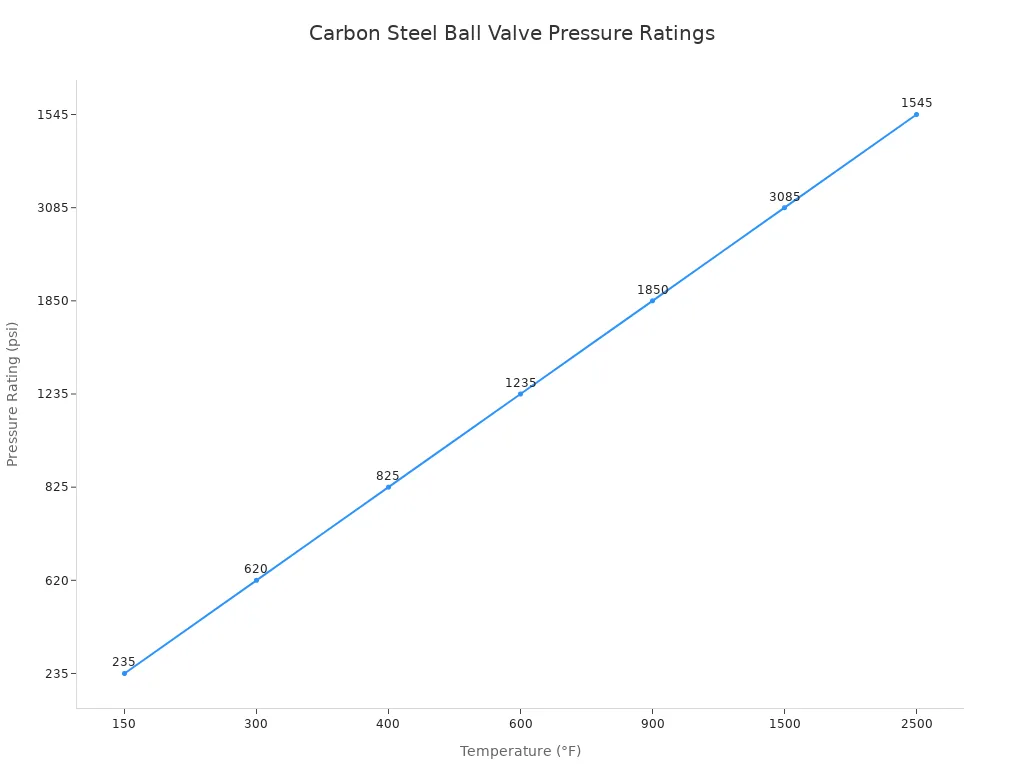
If you want a valve that is strong, pick a carbon steel ball valve. It works well when there is a lot of pressure. It also works well when it gets very hot. The table below shows how carbon steel does better than other materials. It shows the pressure ratings at different temperatures:
Temperature (°F)
Carbon Steel (PSI)
150
235
300
620
400
825
600
1235
900
1850
1500
3085
2500
1545
You see carbon steel valves used in oil and gas. They are also used in many other industries. These valves work well again and again. Some have special features like full port design. Some have safety locks. The 2 Piece 2000 WOG Carbon Steel Ball Valve has these features. If you pick high pressure ball valves made from carbon steel, you get good value. You also get something you can trust for a long time.
Key Takeaways
Carbon steel ball valves are very strong and dependable. They work well in places with high pressure and heat.
These valves have a full port design. This lets more liquid flow through. It also lowers pressure drop. This helps the system work better.
Doing regular maintenance is important. You should check them every month. You should change the seals every year. This helps the valves last longer.
Safety features like blow-out proof stems help keep people safe. Handle locks also stop accidents from happening in factories.
Carbon steel valves can be used in many ways. They work with water, steam, and chemicals. This makes them good for lots of industries.
Carbon Steel Ball Valve Specs
Material Strength
When you pick a carbon steel valve, you get strong material. Carbon steel is stronger than stainless steel and brass. This means it can take more force before breaking. Here is how they compare:
Carbon steel valves are stronger than stainless steel ones.
Brass has a tensile strength between 338 and 469 MPa.
Carbon steel’s mix of elements helps it work well. WCB material has carbon, silicon, and manganese. These make the valve tough and easy to use. You can count on it in hard jobs.
Carbon steel valves work with water, steam, air, hydrogen, ammonia, nitrogen, and oil. They can be used in systems up to 32.0 MPa and from -30°C to 425°C.
You can trust your valve if it meets world standards. The 2 Piece 2000 WOG Carbon Steel Ball Valve meets ANSI B16.34, EN 12516-1, and API 598. These rules make sure your valve is safe and works well. You can pick sizes from 1/2″ to 4″ for your needs.
Tip: Always check the specs before you pick a valve. This helps you avoid mistakes and keeps your system safe.
Corrosion Resistance
Corrosion resistance matters when using valves in chemical gear. If you pick the wrong material, your equipment might break. About 60% of chemical gear breaks because of corrosion. You need to choose wisely.
You can add coatings like epoxy or PTFE to help stop corrosion in chemical uses.
Carbon steel is used for sodium hydroxide below 80°C and up to 30% strength. Sometimes, it can handle more heat and stronger solutions.
You can trust carbon steel valves for many jobs, but always think about what you are using them for. Coatings help your valve last longer in tough places.
Full Port Ball Valve Design
Flow Capacity
When you choose a full port ball valve, you get the best flow possible. The opening inside this valve matches the size of your pipe. This means liquid or gas can move through without getting slowed down. You do not lose flow because there are no tight spots inside the valve.
The full port ball valve has a bore that matches the pipe diameter. This allows for unrestricted flow and higher flow rates.
Reduced port valves have a smaller opening. This creates a bottleneck and limits how much fluid can pass through.
You keep your system running smoothly with a full port ball valve. It works well even when you need to move thick or sticky fluids.
Here is a quick look at why this design helps your system:
Feature
Beschreibung
High Flow Capacity
The large internal diameter lets the most fluid pass through with little resistance.
Minimal Pressure Drop
The design cuts down on turbulence and friction, so you lose less pressure as fluid moves.
Handling Viscous Fluids
Thick or particle-filled fluids move easily, so you avoid clogs and jams.
You want your system to keep its pressure. The full port ball valve helps you do that. The wide opening means fluid does not have to squeeze through a small space. This reduces resistance and keeps pressure steady.
The full port design gives you an unobstructed flow path. This means less resistance and a lower pressure drop.
Less turbulence happens inside the valve. Your system stays efficient, and you save energy.
Industries like oil and gas need to keep pressure high. The full port ball valve is a smart choice for these jobs.
Tip: If you want to boost your system’s efficiency and cut down on energy costs, pick a full port ball valve. You will see better flow and less wasted pressure.
Carbon Steel Valve Performance
Leak Prevention
You want your system to be safe and dry. Leaks can cause big trouble in any project. Carbon steel ball valves can leak for a few reasons. Worn packing, broken seats, or bad installation are common causes. You can stop leaks by picking valves with smart designs.
Packing can wear out or get loose. This causes leaks on the outside. You can fix this by tightening or changing the packing.
If the seat is damaged or dirt gets inside, leaks can happen inside the valve. Checking your valve often helps you find these problems early.
Seals can wear out too. You should look at seats, O-rings, and seals often. Change them if they look bad.
If you do not install the valve right, leaks can happen near the stem packing. Always follow the right steps when you put in a 2-way ball valve or a 3-way ball valve.
Use special materials for seals and keep up with maintenance
Improper Installation
Follow correct installation steps for every valve
A 2-way ball valve has a simple flow path. This makes it easy to find and fix leaks. If you want more control, a 3-way ball valve lets you move flow in different ways. Both types help keep your system tight and safe.
API 598 tests every carbon steel ball valve for leaks. For liquid, only 2 drops per minute per inch are allowed. For gas, only 4 bubbles per minute per inch are allowed. These rules make sure your valves work well.
Tip: Always check your valves before and after you put them in. This helps you find leaks early and keeps your system safe.
Blow-out proof stem keeps the stem from popping out. It uses nickel-plated brass to make it strong.
Adjustable packing gland lets you tighten the seal if it gets loose. It uses pure PTFE and a strong washer for better use.
Handle lock stops people from turning the valve by mistake. You can lock the handle for more safety.
Limited position design helps you control flow and avoid mistakes.
Here is a table that explains these features:
Feature
Beschreibung
Blowout-proof stem
Nickel-plated brass adds durability
Adjustable packing gland
Pure PTFE and reinforced washer for easy adjustment
Maintenance
Lower torque design makes maintenance simple
A 2-way ball valve is good for simple on-off jobs. If you need to mix or move flow, a 3-way ball valve gives you more choices. Both actuated valves have good safety features. You can pick fire safe certified valves for extra safety in risky places.
API 598 testing shows every valve meets tough safety and leak rules. You can trust your carbon steel ball valve to work in hard jobs.
Note: Safety features like blow-out proof stems and handle locks help stop accidents and keep your system working well.
You can use actuated 2-way and 3-way ball valves in many jobs. These valves work in water treatment, oil and gas, and chemical plants. You get strong and safe performance every time.
Ball Valve Applications
Media Compatibility
You can use a carbon steel valve with many fluids. This makes it a good choice for lots of projects. Here are some things that work well with these valves:
Water, like fresh water, sewage, and sea water
Air and steam
Food and medicine
Chemicals, such as oils, acids, alkalis, and salts
If you use a ball valve with strong chemicals, think about chemical resistance. Carbon steel valves often have special coatings or linings. These help protect the valve from things that can cause rust or damage. This matters if you work with strong acids or bases. Some chemicals, like hydrochloric acid or sulfuric acid, can hurt carbon steel over time. Even weak acids might cause rust if the valve touches them for a long time. Always check if your fluid needs extra protection.
Note: Coatings and linings help your valve last longer in tough places.
Industry Use Cases
You will see these valves in many industries. Each industry needs something different, but carbon steel valves work for most jobs. Here are some common uses:
Industry
Common Applications
Key Requirements
Oil & Gas
Pipeline shutoff, wellheads, refineries
High-pressure capability
Chemical
Acid, alkali, and salt solutions
Material compatibility, durability
Leistung
Steam lines, boiler feedwater, cooling systems
High temperature and pressure
Wasserversorgung
Municipal supply, wastewater, desalination
Corrosion resistance, flow control
Food & Pharma
General-purpose fluid control
Versatility, reliability
You might use a standard port ball valve for simple flow jobs. A full port design gives you better flow when you need it. In oil and gas, you need valves that can handle high pressure. In water treatment, you want valves that do not rust. Chemical plants need valves that can stand up to harsh fluids. Power plants use these valves for steam and cooling. Food and drug companies use them for safe and steady work.
A ball valve helps you control flow, shut off lines fast, and keep your system safe. You can trust carbon steel for strength and long life in many places.
Cost & Maintenance
Value Over Time
If you pick a carbon steel ball valve, you make a smart choice. This valve can last for many years and helps your system work well. Most people want to know how long the valve will last before it needs to be changed. Here is what you should know:
A carbon steel ball valve can last 10 to 20 years if you take care of it.
In tough places, it might only last 5 years or less.
Tip: Choosing a strong valve helps you avoid repairs and stops your system from breaking down.
Maintenance Ease
You want your equipment to work well without much trouble. Carbon steel valves are easy to take care of. You can follow a simple plan to keep your valve working. Here is a guide for high-pressure jobs:
Interval
Maintenance Tasks
Monthly
Visual inspection for external leakage, Operation verification, Check for noise
Quarterly
Lubricate stem, Check packing tightness, Clean surfaces, Verify position indicators
Monthly checks help you find problems early. Lubricating and cleaning every few months keeps the valve working well. Once a year, look inside and change any old parts. This plan helps your ball valve last longer and keeps your system safe.
Note: Taking care of your valve often helps it last longer and saves you money.
You get lots of good things with a carbon steel ball valve. These valves last a long time. They let lots of liquid or gas move fast. You can open and close them quickly. The 2-teiliger 2000 WOG-Kugelhahn aus Kohlenstoffstahl is special. It can handle 2000 PSI. It has a strong TFE seat. It also has safety parts.
The table below shows the main strong points:
Strength
Beschreibung
Durability
Lasts long, needs less fixing
Safety
Stem won’t pop out, handle locks
Versatility
Works with many fluids and setups
Think about using a carbon steel ball valve for your next job.
FAQ
What media can you use with a carbon steel ball valve?
You can use water, air, steam, oil, chemicals, and even food products. Carbon steel ball valves work well with many types of fluids. Always check if your media needs extra protection or coatings.
How do you maintain a carbon steel ball valve?
You should inspect the valve every month. Lubricate the stem and check the packing gland. Clean the surfaces and replace seals once a year. Regular care helps your valve last longer.
What safety features does the 2 Piece 2000 WOG Carbon Steel Ball Valve have?
You get a blow-out proof stem, adjustable packing gland, and a handle lock. These features help prevent accidents and keep your system safe.
Can you use carbon steel ball valves in high-pressure systems?
Excellent and very specific question. Choosing between C95800 Und C95500 is a classic materials selection dilemma in the oil and gas industry. While both are aluminum bronzes, their differences are significant and will directly impact your project’s performance, cost, and safety.
Here’s a detailed comparison to guide your decision.
At a Glance: Key Differences
Feature
C95800 (Nickel-Aluminum Bronze)
C95500 (High-Strength Aluminum Bronze)
Why It Matters
Primary Standard
ASTM B148 (Cast)
ASTM B148 (Cast)
Both are standardized, but for different primary purposes.
Key Composition
Cu + Al (~9%) + Fe (~4%) + Ni (~5%)
Cu + Al (~11%) + Fe (~5%) + Ni (~4%) + Mn
C95500 has higher Al and Fe, giving it higher strength. C95800 uses Ni for corrosion resistance.
Corrosion Resistance
Superior. Excellent resistance to saltwater, impingement, and sour service (H₂S).
Very Good. Good general corrosion resistance, but not as strong as C958 in critical sour or marine environments.
C95800 is the definitive choice for offshore/marine and confirmed sour service.
Mechanical Strength
High. Tensile Strength: ~110 ksi (758 MPa)
Higher. Tensile Strength: ~116 ksi (800 MPa)
C95500 can handle slightly higher mechanical loads and stresses.
Hardness
High. Brinell Hardness: ~170-210 HB
Higher. Brinell Hardness: ~200-240 HB
C95500 offers better resistance to abrasive wear from sand and particulates.
Weldability & Repair
Fair to Good. Requires specialized procedures.
Poor. Very difficult to weld and repair without cracking.
C95800 is generally more repairable in the field, a key maintenance consideration.
Cost
Higher (due to Nickel content)
Slightly Lower
C95800 typically commands a premium due to its enhanced corrosion properties.
Primary Application Driver
Corrosion Resistance (especially to seawater & H₂S)
Strength & Abrasion Resistance
This is the fundamental trade-off.
Detailed Breakdown for Your Oil Project
When to Choose C95800:
Choose C95800 when corrosion resistance is the overwhelming priority. This is the “Marine-Grade” and “Sour Service” champion.
Offshore & Marine Applications: This is C95800’s home turf. Its superior resistance to saltwater corrosion, cavitation, and erosion makes it the default choice for:
Seawater cooling systems
Ballast water systems
Firewater systems on platforms and FPSOs
Sour Oil & Gas (H₂S) Service: C95800 has excellent resistance to Sulfide Stress Cracking (SSC). If your process fluids contain hydrogen sulfide, C95800 is the much safer and more reliable choice. It is commonly specified for:
Wellhead injection lines (methanol, glycol)
Flow lines handling sour crude
Chemical injection systems
Where Long-Term Reliability Trumps Initial Cost: You are investing in maximum uptime and minimized risk of failure in a corrosive environment.
When to Choose C95500:
Choose C95500 when you need maximum strength and abrasion resistance in a less severely corrosive environment.
Abrasive Onshore Service: If your primary challenge is sand, silt, and other particulates in the flow stream (e.g., in onshore production or frac lines), C95500’s higher hardness provides better resistance to abrasive wear.
High-Pressure/High-Stress Applications: Its higher tensile and yield strength make it suitable for applications with significant mechanical load where the corrosion environment is less aggressive (e.g., high-pressure water, non-sour hydrocarbons).
Cost-Conscious, Demanding Applications: When you need high strength and good corrosion resistance (but not the absolute best) at a slightly lower cost than C95800.
For the vast majority of 2025 oil projects, especially offshore or those involving sour crude, C95800 is the more future-proof and lower-risk choice. Its exceptional performance in corrosive environments justifies its premium cost by drastically reducing the risk of catastrophic failure, unscheduled downtime, and environmental incidents.
Reserve C95500 for specific, well-defined onshore applications where abrasion is the known primary destructive force and the corrosion profile is mild and well-understood.
Final Tip: Always base your final decision on a Project-Specific Risk Assessment. Review your Process Flow Diagrams (PFDs) Und fluid composition reports. When in doubt, especially for anything offshore or sour, specifying C95800 is the conservative and recommended engineering choice.
Knife gate valves are important parts in controlling fluids in factories. They give a strong shutoff and help control flow well. These valves are tough and can handle rough slurries, strong chemicals, and high pressure. Many industries use knife gate valves because they last long and work well. Some common uses are:
Choosing the right valve and taking care of it helps you get the most from knife gate valves. This makes sure they work well for a long time, even in hard places.
Key Takeaways
Knife gate valves have a sharp gate. This gate cuts thick fluids and solids. It stops clogs and keeps flow strong. These valves work well in hard jobs.
Picking good materials and seals is important. Stainless steel and PTFE are good choices. They help valves fight rust. They also help valves last longer in tough places.
There are different ways to open and close valves. You can use handwheels or pneumatic systems. You can choose what works best for you.
Right size, good setup, and regular care are needed. These steps help knife gate valves work well. They also help stop factory downtime.
Knife gate valves are used in many industries. Mining, energy, chemical, and food all use them. They shut off flow well and handle rough fluids safely.
Knife Gate Valve Design
Main Features
Knife gate valves are special because of how they are made. The sharp gate can cut through solids and slurries. This helps stop clogs and keeps the valve working well. The valve body is made from GGG40 ductile iron. This material is strong, flexible, and does not wear out fast. The tough build lets the valve handle rough liquids and high pressure. An epoxy coating protects the valve even more. This makes it good for harsh places.
A full port design is very important. It matches the pipe’s inside size. This lets more liquid flow and lowers pressure loss. The design helps the flow move better and stops too much mixing. Knife gate valve parts are the gate, body, stem, seat, and actuator. The double plane bearing screw drive makes turning the valve easy. It lowers friction so you can open and close it by hand. The valve is small and fits in tight spots. This is helpful in many factories.
Tip: The sharp gate and full port design help stop clogs. They keep the valve working well, even with rough or gritty liquids.
Stops all leaks and emissions in tough jobs, better than other valves
Materialien
Knife gate valve parts use many materials for different jobs. The GGG40 ductile iron body is strong and does not wear out fast. This helps the valve last longer in mining, paper, and water plants. Stainless steel like 304, 316, and 316L does not rust. It is good for chemicals and food. Cast steel and carbon steel work for higher heat and pressure. PTFE lining protects against strong acids and bases. This makes the valve good for chemical plants.
Corrosion Resistance and Performance in Corrosive Environments
Typical Applications and Conditions
Edelstahl
304, 316, 316L
Does not rust, even with salty or harsh liquids; 316L is best for stopping rust inside.
Used in chemical, food, and drug factories; works with acids, bases, and salt; can handle very hot or cold temperatures
Kohlenstoffstahl
Q235, WCB
Very strong but needs extra care in harsh liquids.
Used in pipes with medium heat and pressure, but not strong chemicals; works in a wide temperature range
Gusseisen
Gray cast iron, ductile cast iron
Not as good at stopping rust; best for low heat and pressure.
Used in city water and sewage; works at lower pressure and temperature
Cast Steel
WCB
Stronger and tougher than cast iron; handles more heat and pressure.
Used in mining and power plants; works with high pressure and heat
Fluorine Lining
PTFE
Stops damage from strong acids and bases; lasts long and is slippery.
Used in chemical plants and electroplating; handles very harsh liquids and wide temperatures
Ceramic
Various ceramic materials
Very hard and does not wear out; does not react with chemicals.
Used in mining, waste water, and cement; works at high heat
Seal Materials
PTFE, NBR, EPDM, hard alloys
PTFE stops rust; NBR resists oil; EPDM lasts in sun and air; hard alloys are very tough.
Used for sealing in tough, hot, or rough places in many industries
The material you pick for knife gate valve parts changes how well it works. Stainless steel and PTFE seals stop leaks and keep a tight seal, even with strong chemicals. The strong body can take hits and stress. This is important for mining and power plants.
Sealing Mechanisms
Sealing is very important in knife gate valve design. The valve uses packing glands with soft materials like PTFE or graphite. These make a tight seal around the moving gate. This stops leaks. The packing gland moves as the gate moves. This keeps the seal tight, even when cutting thick stuff.
Knife gate valve parts have metal seats made from hard steel or special alloys. These seats last long and can take high heat and pressure. PTFE packings resist chemicals and slide easily. This helps the seal work better and last longer. These features keep the seal tight and help the valve last.
Some valves have seats that move and use O-rings. This design fixes wear by itself and keeps the seal tight. You can pick metal hard seals or soft seals like PTFE, special PTFE, tri-propylene, or butyl rubber. The choice depends on what the valve will handle. Metal seats are best for tough jobs. PTFE and rubber seats are good when you need no leaks and careful control.
Note: Some advanced sealing systems in Severe Service Knife Gate Valves stop all leaks and emissions. This makes them great for tough factory jobs.
The full port design also helps the seal work better. It lets liquid flow without being blocked. This lowers mixing and pressure loss. It helps keep the seal tight and the flow smooth. All the knife gate valve parts work together to stop leaks and keep the valve working, even in hard jobs.
How Knife Gate Valves Work
Operation Principles
Knife gate valves use a simple way to control flow. The main part is a sharp gate that moves up and down. When you lift the gate, it gets out of the way. This lets liquids and solids move through easily. When you lower the gate, it presses tight against the seat. This blocks the flow and makes a strong seal.
The gate goes up or down to open or close.
When open, the gate is above the flow, so liquid moves freely.
When closed, the gate drops and seals the seat, stopping flow.
The sharp edge cuts through thick or gritty stuff, stopping clogs.
The design helps in tough jobs. The blade can cut debris and press tight for a good seal. Some valves can open partway for flow control. But full open or closed is best for long life. The valve is small and works both ways, making it useful.
Note: Knife gate valves have smooth sealing surfaces and tough materials. This helps them work well in hard places.
Actuation Options
There are different ways to open and close knife gate valves. The most common way is by hand with a handwheel. Turning the handwheel moves the stem up or down. The double plane bearing screw drive lowers friction. This makes it easier to use by hand, even with high pressure. The smooth action stops tired hands and gives good control.
Other ways include pneumatic, electric, and hydraulic systems. Pneumatic actuators use air to move the gate fast. These are good for remote or automatic control. Electric actuators move the gate with power and fit into automatic systems. Hydraulic actuators use fluid for strong and steady movement, good for big valves.
Tip: Pick the actuation method that fits the job. Hand operation is good for small or rarely used valves. Pneumatic and electric are better for automatic or remote use.
The double plane bearing screw drive is special in manual valves. It lowers friction when you turn the valve. This means you use less effort to open or close it. The smooth movement also helps the valve last longer by lowering wear.
Knowing how knife gate valves work helps you pick the right one. The best actuation and smooth use make sure the valve works well in any factory.
Types of Knife Gate Valves
Knife gate valves come in different types for many jobs. Knowing about these types helps people pick the right valve for their work.
Standard Types
Standard knife gate valves have a sharp disc that moves up and down. This disc can cut through thick slurries and sticky fluids. The body is short and light, so it is easy to put in. These valves use metal or soft seats to stop leaks. Some can seal both ways, but most work best in one direction.
Ventiltyp
Design-Merkmale
Applications and Media Handled
Standard Knife Gate
Sharp disc, short body, metal or soft seats, one- or two-way seal options
Used in pulp and paper, wastewater, chemical plants, mining, cement; good for thick fluids and stringy pulp
Standard knife gate valves are used in paper mills, water plants, and chemical factories. They work with many fluids and are simple to set up.
Slurry and Heavy-Duty Types
Slurry and heavy-duty knife gate valves are made stronger. They have tough seals and metal seats for rough slurries and hard solids. The gate edge is extra hard to last longer. These valves are good for mining and other hard jobs.
Heavy-duty valves can take high heat and pressure, so they are used for hot or rough materials.
Tip: Slurry knife gate valves help stop clogs and last longer, so you fix them less and save money.
Specialty Designs
Specialty knife gate valves solve special problems in some factories. They use different seat materials like EPDM, PTFE, or NBR to fight chemicals or wear. Some have rising or non-rising stems, special coatings, or gates that help control flow.
These valves are made to not trap solids, so they clog less. They also have better seals to stop leaks, even when the pressure is high. Specialty valves are used in chemical plants, food factories, and power plants where fluids can be rough, corrosive, or have solids.
Note: Checking and caring for specialty knife gate valves helps them last longer, especially in tough places.
When you know about the types and uses of knife gate valves, you can pick the best one for your job and make sure it works well.
Performance Factors
Pressure Ratings
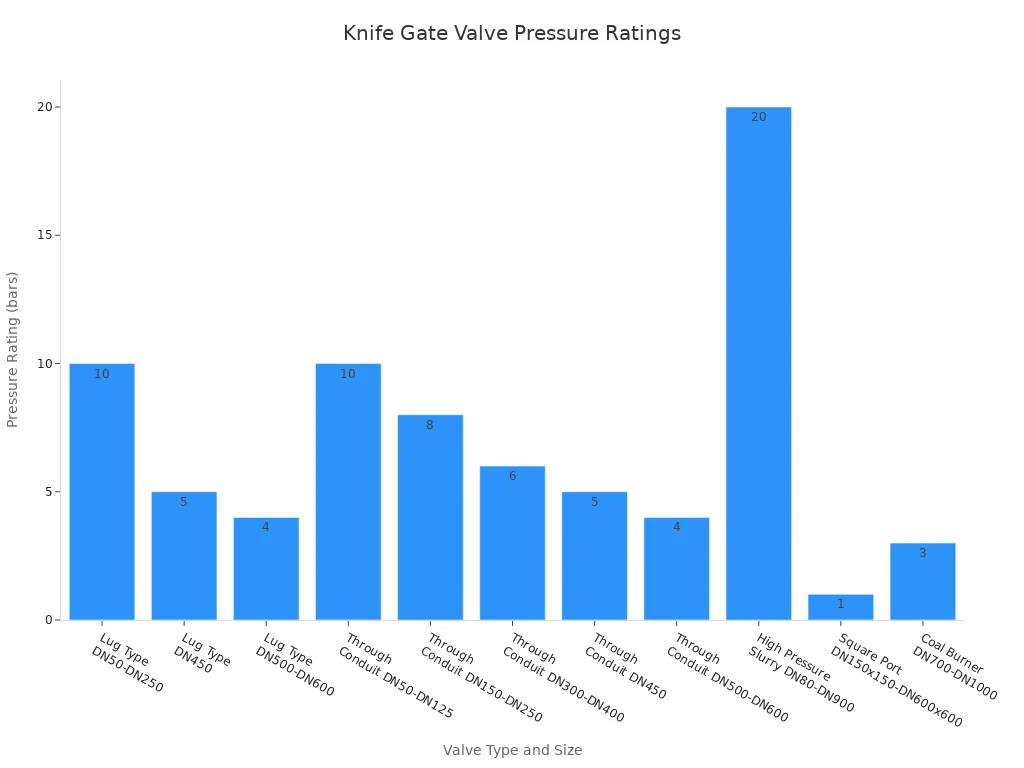
Pressure ratings are very important for how a valve works. High-performance knife gate valves can handle high pressure. They often work as well as or better than regular gate valves. Most knife gate valves can take pressure from 1 bar up to 20 bars. The size and type of the valve change how much pressure it can handle. For example, a lug type knife gate valve in sizes DN50-DN250 can take up to 10 bars. Some high-pressure slurry models can handle up to 20 bars. The table below shows the usual pressure ratings for different types and sizes:
High-performance knife gate valves shut off flow very well. They keep their pressure ratings even when things get tough. This makes them a good choice for many factories.
Media Handling
Knife gate valves work well with many kinds of liquids and solids. They can control water, oil, gas, and thick slurries. The sharp gate lets the valve cut through thick and chunky fluids. Some knife gate valves have special liners and hard gates. These parts help the valve last longer and keep leaks away, even with harsh or strong liquids.
Factories use these valves for slurries, dry stuff, and high-pressure flows. The full port design helps stop clogs and lets things move smoothly. Knife gate valves can also handle changes in temperature and chemicals without problems.
Tip: Picking the right seat and body material helps the valve work better with different liquids.
Reliability
Reliability is a big reason why factories pick high-performance knife gate valves. These valves are built strong and use materials that do not rust. They have special seals that help them work well for a long time. Many knife gate valves use seats and O-rings that move to fix wear. This keeps the seal tight and stops leaks.
Knife gate valves last longer in tough jobs. They need less fixing and break down less than other valves. This means factories have less downtime and save money.
Note: Checking the valve often and putting it in the right way helps it stay reliable and work well.
Valve Selection Criteria
Sizing
Getting the right size is important for the valve to work well. Knife gate valves can move thick fluids and solids like slurry and sludge. They are small and light, so they fit in tight places. But they are not the best for high-pressure jobs. If you use dry or grainy stuff, the valve might not work as well. You should think about what will flow through the valve. Checking and fixing the valve often keeps it cutting and sealing well.
Key things to think about for sizing are:
Make sure the valve size matches the pipe size.
Check that the pressure rating is right for your system.
Think about what is flowing, especially if it has solids.
Pick the best connection type, like wafer, lug, or flange.
Low friction materials like PTFE help the valve last longer.
Guide Rings
These stop liquid from sitting still in harsh or rough fluids.
Lining Materials
PTFE lining seals better; polyurethane lining helps with wear from ores.
Valve Connection Types
Wafer, lug, and flange types work for different ways to install the valve.
Flushing Devices
These clean out the valve and help it last longer and seal better.
Spezifikation
Picking the right kind of valve keeps it safe and working well. The materials must work with what flows through the valve. Stainless steel, cast iron, and special metals are used a lot. The valve must handle more pressure and heat than your system makes. Seals like EPDM or NBR should match what is inside the pipe. Metal seats are tough for rough stuff but may not seal as tight. How much leaking you can allow also helps you pick the seat.
Know what you will use the valve for, like thick slurries or solids.
Choose materials that work with your system and what flows through it.
Tip: Always make sure the valve follows safety rules and works well.
Environmental Considerations
Where you put the valve matters a lot. There might not be much space or you may need to reach it easily. Very hot, cold, or chemical places can change what materials you need. You should also think about rust or things that can wear out the valve. Picking the right valve keeps things safe and helps it last longer.
Think about space, how easy it is to reach, and the place where you put the valve.
Temperature Range
Use materials and seals that stay strong in your system’s heat or cold.
Actuation Type
Choose manual or automatic opening based on how you want to control the valve and your budget.
Note: Paying close attention to where and how you use the valve keeps it safe and working for a long time.
Industrial Applications
Knife gate valves are very important in many industries. Their design helps them work in lots of different jobs. The GGG40 knife gate valve can handle water, oil, gas, and strong liquids. This makes it a good choice for tough places.
Energy and Petrochemical
Knife gate valves are used in power plants and petrochemical factories. Workers use these valves to control ash slurry and cooling water. They also help with other waste from the plant. The valves shut off flow well and do not leak much. This keeps things safe and helps the plant run better. In petrochemical plants, knife gate valves control strong, sour, or thick liquids. The right material is important, so workers pick high alloy types like Hastelloy or Inconel for hard jobs.
Typical applications in these sectors include:
Moving slurry and wastewater
Controlling fluids with solids
Transferring and stopping fluids
Managing wastewater
Sector
Typical Applications
Key Benefits
Energy
Ash slurry, cooling water
Reliable, needs little fixing
Petrochemie
Strong liquids, fluid transfer
Good shut-off, keeps things safe
Mining and Paper
Mining and paper factories use knife gate valves to control thick and rough fluids. In mining, these valves move mineral slurries and stop clogs. This makes work safer and saves time. Stainless steel helps the valve last longer and lowers repair costs. In paper mills, knife gate valves control rough pulp and slurries with lots of fibers. Their strong build helps them last longer than other valves.
Key uses in these industries:
Good flow control for rough slurries
Tight seal to stop leaks
Handling recycled fibers and dirt
Helping with quality and safety goals
Tip: Self-cleaning parts help stop stuff from building up. This makes the valve work better and need less fixing.
Chemical and Food
Knife gate valves are very useful in chemical and food plants. In chemical factories, valves made from strong materials handle harsh stuff safely. This keeps workers safe and stops leaks. In food plants, knife gate valves meet clean rules by sealing well and being easy to clean. Workers use these valves to control thick foods like sauces and syrups. This helps keep things clean.
Common applications include:
Handling sewage and dirty stuff
Moving thick and grainy materials
Making sure shut-off is tight with little leaking
Industry
Typical Applications
Safety and Hygiene Features
Chemical
Strong liquids, cleaning sewage
Stops rust, seals tightly
Food
Sauces, syrups, grainy stuff
Clean design, easy to wash
Knife gate valves work well in high-pressure and clean places. Their many uses help lots of factories, so many workers choose them.
Installation and Maintenance
Installation Steps
Putting in knife gate valves the right way is important. This helps them work safely and last longer. Workers should always use good steps when installing to stop problems later.
Using too much force, wrong materials, or not lined up right
Be gentle, use better materials, check and change stems when needed
Stem Sticking or Difficulty
Packing gland too tight, not enough space, or rough stem
Loosen the packing, keep the stem smooth, make sure it lines up
Leakage at Bonnet or Body
Bolts not tight the same, bad seals, wrong packing
Tighten bolts evenly, check and change seals, use the right packing
Gate Jamming or Partial Closure
Dirt, not lined up, or worn parts
Clean out dirt, oil moving parts, fix the alignment
Seat Erosion or Damage
Rough liquids, heat changes, or wrong size
Use tough seat materials, check often, make sure the size is right
Corrosion and Material Degradation
Bad fluids, very hot or cold, or wrong coating or material
Use rust-proof metals, add coatings, check the environment
Workers should learn how to use valves the right way. This stops damage from using too much force or using them wrong. Oil the stem and gears when needed. Tighten bolts in a crisscross way to stop leaks. Adjust packing bolts carefully and do not make them too tight. Change old or broken parts fast to keep the valve working well.
Knife gate valves work well to stop and control flow in tough places. They have strong parts, sharp gates, and different ways to open or close them. Picking the right valve type, size, and materials keeps things safe and working right.
Looking at valves often and following the rules keeps the system working well.
FAQ
What makes a knife gate valve different from a standard gate valve?
Knife gate valves have a sharp gate that cuts thick slurries and solids. Standard gate valves cannot move these materials as well. The knife gate design stops clogs and gives a strong shutoff. This helps in tough factory jobs.
How should operators choose the right seal material?
EPDM Knife Gate Valve
Operators need to match the seal to what flows inside. PTFE is good for chemicals. Metal seats work with rough slurries. EPDM and NBR are best for water and mild chemicals. Always check if the seal fits the fluid for best results.
Can knife gate valves handle both liquids and solids?
Yes, knife gate valves can control liquids and solids. The sharp gate slices thick fluids, slurries, and dry bulk stuff. This design helps stop blockages and keeps things running smoothly in hard jobs.
How often should maintenance be performed on a knife gate valve?
Maintenance should happen every few months. Operators must check for worn parts, clean moving pieces, and change seals if needed. Regular checks help the valve last longer and work well.
What industries benefit most from using knife gate valves?
Knife gate valves are used in mining, energy, petrochemical, chemical, paper, and food jobs. These places need strong shutoff and flow control for slurries, harsh fluids, and bulk stuff. The tough design works well in hard factory jobs.
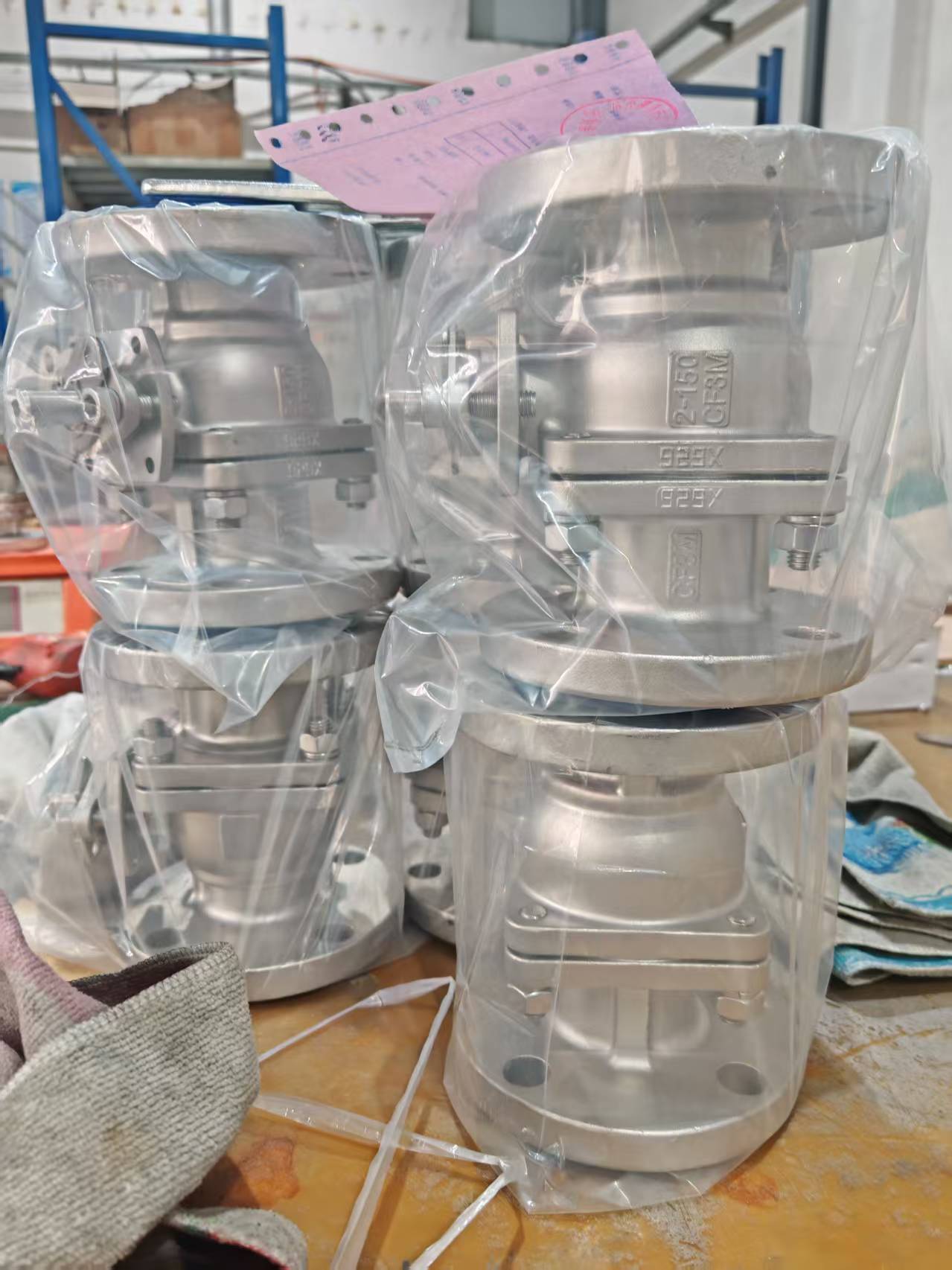
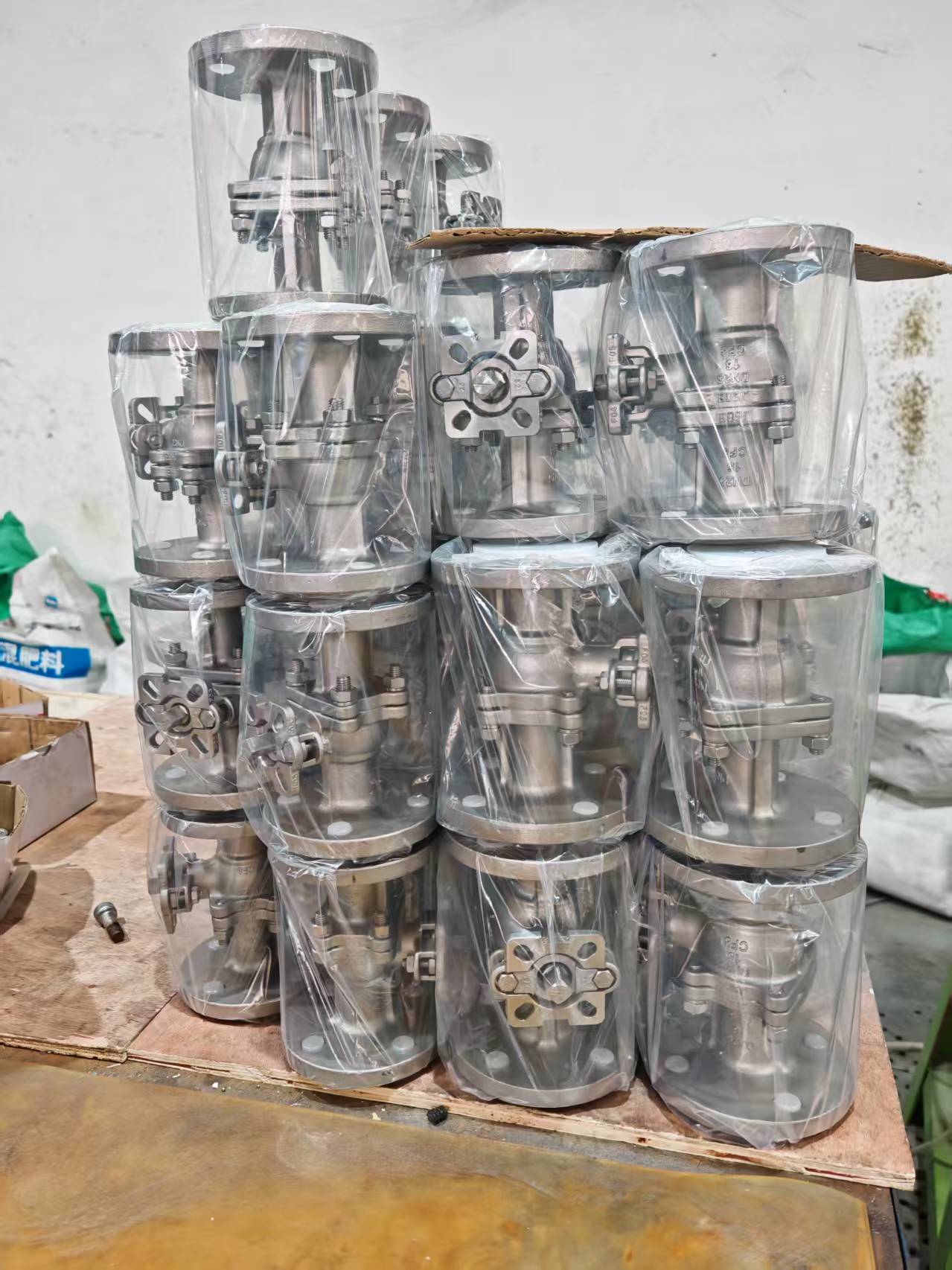
China 2PC Flanged Ball Valve,stainless steel ball valve,2 piece flanged floating ball valve,Ball Valve Direct Mounting Pad, Direct Mounting Flanged End Ball Valve,Flanged Ball Valve,Direct Mounting Pad Ball Valve Manufacture
The 2pc ball valve flanged end with direct mounting pad is often a good choice for many factories. Engineers look at many things when picking a valve. They check if it fits the system, what kind of fluid it will handle, how much pressure it can take, the temperature it can handle, if it can be automated, and if it meets rules like API 607 and ISO 9001.
Industry rules want the valve to be made of stainless steel, to shut off tightly, and to have proof it is safe and good quality. Knowing the good and bad points helps workers pick the best 2pc ball valve for their job.
Key Takeaways
The 2PC ball valve with flanged end and direct mounting pad has a strong seal. It is easy to install. It can be used with machines for faster work in factories.
Its stainless steel body and strong seals make it last long. It is safe to use. It works well with tough liquids and high pressure.
This valve saves energy. It lets fluids move fast with little pressure loss. This helps lower costs and stops long breaks in work.
Checking the valve often and picking the right materials helps it last longer. This also stops leaks and keeps systems safe and working well.
Picking the right valve size, materials, and certifications is important. This helps the valve fit your system and work better.
2PC Ball Valve Overview
2PC Ball Valve Overview
Design and Construction
The 2pc ball valve is strong and lasts a long time. It is made with stainless steel 304, which does not rust easily. The valve has two main parts joined by bolts or threads. This makes it simple to put together and fix. The flanged end helps stop leaks and makes it easy to install. The direct mounting pad follows ISO 5211 rules and lets you add an actuator for automation. The full bore inside lets fluid move fast and keeps pressure low. The blowout-proof stem, reinforced PTFE seat, and graphite seal help the valve work well and stay safe. There are also double O-rings, Belleville washers, and an antistatic device to make it even better. The valve meets API, ASME, and ISO rules, so it works for tough jobs. STV Valve Technology Group Co., Ltd makes this valve in sizes from DN15 to DN200. It can handle pressure up to 150LB and works in temperatures from -20°C to 180°C.
Hauptmerkmale
Feature
Beschreibung
Volle Bohrung
Lets fluid move easily and quickly
Flanged End
Makes sure the valve does not leak
Direct Mounting Pad (ISO 5211)
Lets you add an actuator for automation
Reinforced PTFE Seat
Stays strong against chemicals and lasts long
Graphite Seal
Helps keep the valve safe in fires and high heat
Blowout-Proof Stem
Stops the stem from popping out under pressure
Antistatic Design
Lowers static electricity for safer use
Double O-Ring Stem Sealing
Helps stop leaks and makes the valve more reliable
Belleville Washers
Keeps the packing tight and steady
Compliance
Follows API, ASME, and ISO rules
These features help the 2pc ball valve work well and last a long time in factories.
The 2pc ball valve can control many fluids like water, oil, natural gas, acids, and other harsh liquids. Its strong build and good sealing make it a top pick for jobs that need safety, strength, and steady work.
Ball Valve Pros and Cons
Advantages of 2PC Ball Valve
Engineers pick the 2PC ball valve for many reasons. It can shut off flow very fast, which helps control fluids right away. The full bore lets liquids move easily, so there is less pressure loss. This saves energy and helps lower bills. The stainless steel body does not rust, so it works well in tough places like oil rigs and chemical plants.
Der direct mounting pad lets workers add actuators easily. This makes automation simple and helps factories work better.
The valve seals tightly, so leaks are rare. Fire-safe and antistatic features help keep people and machines safe. The blowout-proof stem and double O-ring stem sealing make it even safer. The valve follows strict rules like API and ASME, so it fits many jobs.
It is easy to install, so setup is quick.
The strong seal stops leaks and lasts a long time.
You can use automation to control it from far away.
Fire safety helps stop accidents.
It does not rust, so it lasts longer.
It meets world standards for safety and quality.
It is simple to fix, so repairs cost less.
The 2PC ball valve is very tough. It has fewer moving parts, so it breaks less often. The strong build means you do not need to replace it often. Over time, companies spend less on repairs and have fewer problems, even in hard places.
Disadvantages of 2PC Ball Valve
The 2PC ball valve is not perfect for every job. It may not work with all fluids or pressures. Big sizes and flanged ends need more space and make the system heavier. It costs more at first than some other valves, but it lasts longer and needs less fixing.
In some places, fixing the valve can be harder if it works in very tough conditions. High heat, rough liquids, or heavy use mean you must check it more often.
It is big and heavy, so it may not fit small spaces.
It costs more at the start than simple valves.
Hard jobs may need more care and checking.
It does not work for every fluid or pressure.
Even with these issues, the 2PC ball valve is still a top pick for many factories. It is easy to fix and works well, so companies avoid leaks and long stops. Its strong build and fire-safe parts make it a safe and smart choice for important jobs.
Advantages and Disadvantages of Ball Valves
Industrial Benefits
Ball valves have many good points for factories. They let fluids move fast and keep pressure steady. This helps machines work well and not break down. The table below shows the main benefits and how they help factories work better:
Ball valves last a long time. They work well even in tough places with high pressure, heat, or strong chemicals. Their simple shape means fewer parts break, so workers do not need to fix them often.
Potential Limitations
Ball valves have some problems too. People should think about the good and bad sides before using them for important jobs. Some issues can make the system less safe or break rules.
You still need to check and fix the valve sometimes. Even though it needs less fixing, regular checks stop leaks and help keep things safe.
Workers should always check if the valve’s pressure and temperature ratings fit the job. Picking the right materials and checking the valve often helps stop leaks and keeps everyone safe.
Ball valves must follow strict rules like ANSI and ISO. These rules help keep the system safe and make the valve last longer in factories.
Comparison With Other Ball Valves
Comparison With Other Ball Valves
1PC vs 2PC vs 3PC
Ball valves have different designs. Each type has special features. The 1PC ball valve has one body piece. It has fewer parts, so it leaks less and costs less. But it works best in simple jobs with low pressure.
Der 2PC ball valve has two body pieces joined together. Workers can take it apart for fixing without cutting the pipe. It fits more sizes and handles more pressure. Many factories use it because it is easy to fix.
The 3PC ball valve has three body pieces. Workers can remove the middle part for cleaning or repairs. They do not need to touch the pipe. This makes fixing fast and easy, even in hard jobs. The 3PC valve uses strong seat materials like PTFE or PEEK. These seats work well with high heat and pressure.
Ventiltyp
Struktur
Maintenance
Best Use
1PC
One-piece
Harder
Simple, low-pressure jobs
2PC
Two-piece
Easier
Industrial, frequent service
3PC
Three-piece
Easiest
Complex, high-maintenance jobs
Flanged vs Threaded/Welded Ends
How a valve connects to a pipe matters. Flanged ends use bolts and gaskets. This makes a strong seal. It is easy to put in or take out. Flanged valves work well with high pressure and heat.
Threaded ends screw onto the pipe. This is quick and simple. But it may leak after some time. It is best for low-pressure jobs. Welded ends give the tightest seal. They stop leaks very well. But you need skilled workers to install them. Welded valves are hard to remove or fix.
Flanged ends are strong, stop leaks, and are easy to fix. They work best for most factory jobs.
Direct Mounting Pad vs Traditional
A direct mounting pad lets workers put an actuator right on the valve. It follows ISO 5211 rules, so many actuators fit. You do not need extra brackets. This makes the valve lighter and smaller. It is faster to install and has fewer parts to check.
Traditional mounting uses brackets or kits. This takes more steps to set up. It can cause more problems. Direct mounting pads make the valve steadier. They help automation and save time. Factories do not need to fix them as much.
Direct mounting pads make automation easy. They help valves work well in modern factories.
Choosing the Right 2PC Ball Valve
Key Selection Criteria
Picking the right 2PC ball valve takes careful thought. Engineers first see if the valve can handle the system’s pressure and temperature. They pick materials that do not rust and are safe for the fluid. Stainless steel works for many jobs, but sometimes PVC or PP is better for special chemicals. The seal, like PTFE or EPDM, must stand up to the fluid and heat.
Valve size and flow rate are important for good work. A full bore design helps the system run well. How the valve connects—flanged, threaded, or welded—changes how you put it in and fix it later. Automation choices, like manual or electric actuators, depend on how often you use the valve and how much control you need. Rules like API and ISO help buyers pick safe and good quality valves.
Certification and regular tests show the valve will work well in tough places.
Application Checklist
A simple checklist helps engineers see if the valve is right:
Check the system’s pressure, temperature, and flow rate.
Make sure the valve’s materials match the fluid.
Pick the right size for best flow and low pressure drop.
See if it meets rules like API 598 and ISO 9001.
Look for certification marks and test papers.
Check if there is enough space and the right connection.
Plan for easy fixing and regular checks.
Choose a maker with good quality checks and clear tests.
Keep a log to track when you check and fix the valve.
Step
What to Check
Pressure/Temperature
Ratings match system requirements
Material
Suits fluid and environment
Size/Flow
Proper sizing for efficiency
Standards
Meets API, ISO, and other certifications
Maintenance
Easy to service and repair
When to Consider Alternatives
Sometimes, another valve is a better choice. If you need to fix the valve often without stopping the pipe, a 3-piece ball valve is easier to service. For jobs that need careful flow control, Kugelventile work better, but they slow the flow more. In systems with lots of use or high pressure, special valves may work best.
Talking to a valve expert helps you get the best valve for any special job.
FAQ
What industries use the 2PC ball valve flanged end with direct mounting pad?
Many types of factories use this valve. Chemical plants, oil refineries, water treatment plants, and food factories pick it often. The valve is good for places that need strong and safe flow control.
How does the direct mounting pad help with automation?
The direct mounting pad follows ISO 5211 rules. Engineers can put actuators on fast. This makes automation simple and saves time. Factories can control the valve from far away with less work.
What maintenance does this valve require?
Workers should check the valve often to keep it working well. They need to look for leaks, test the seal, and clean it. Oiling moving parts helps stop them from wearing out. Doing regular checks helps the valve last longer.
Can the 2PC ball valve handle corrosive fluids?
Yes, the stainless steel 304 body does not rust easily. The reinforced PTFE seat and graphite seal give more safety. This design lets the valve work with many harsh fluids in factories.
Pn160 Metal Seat Ball Valve,C276 Metal Seat Ball Valve
Choosing between a soft seat ball valve vs metal seat ball valve depends on your system’s specific requirements. You need to consider factors like temperature, pressure, sealing capability, and cost. The table below highlights the key differences:
When deciding between a soft seat ball valve vs metal seat ball valve, metal seat valves are ideal for demanding applications or extremely high temperatures. On the other hand, soft seat ball valves provide better shutoff and cost savings in clean, low-pressure environments.
Key Takeaways
Soft seat ball valves close tightly and are cheaper. They work well in clean systems with low pressure and chemicals.
Metal seat ball valves can take high heat and pressure. They also handle rough fluids and last longer in hard jobs.
Pick soft seats if you want a tight seal and easy use. Choose metal seats if you need them to last and handle high heat.
Make sure the valve seat fits your fluid, heat, and pressure. This helps stop leaks and keeps things safe.
Ask an expert for help with hard or important systems. This helps you pick the right valve and saves money.
Soft Seat Ball Valve vs Metal Seat Ball Valve
Key Differences
When you look at a soft seat ball valve vs metal seat ball valve, you see they are built differently.
Soft seat ball valves have seats made from plastics like PTFE, RPTFE, nylon, PEEK, or Devlon. These plastics help the valve seal well and work with many chemicals.
Metal seated valves use strong metals like stainless steel, MONEL, or have coatings such as chromium carbide or tungsten carbide. These metals make the valve tough and able to handle hard jobs.
Soft seat ball valves are best for clean systems with low pressure. Metal seated valves are made for rough places with high pressure or heat.
Sealing and Performance
Sealing is very important when picking a soft seat ball valve vs metal seat ball valve. Soft seat valves seal very well. They can stop leaks so no bubbles get through during tests. This is great for places where leaks are not allowed, like chemical or medicine factories.
Metal seat valves do not always seal perfectly. They let a tiny bit of fluid leak, usually less than 0.01% of what the valve can hold. This is still very little and meets safety rules. Metal seat ball valves work well in tough places, like high heat, rough fluids, or when used a lot. They last a long time and do not wear out fast, even if they do not seal as tightly.
Tip: If you need no leaks, pick a soft seat ball valve. If you want a valve that lasts in tough places, choose a metal seat valve.
Temperature and Pressure Limits
Temperature and pressure are important when choosing a valve. Soft seat ball valves can handle heat up to about 572°F if you use special PTFE seats. Most soft seats start to break down above 450°F. They work best at normal pressure.
Metal seat valves can handle much higher heat and pressure. Many meet safety standards and can work at very high pressure and heat, up to 1200°F or more. This makes them good for hard jobs, like steam, melted metals, or high-pressure gas.
Here is a chart that compares how much heat different seats can take:
Soft seat ball valves and metal seat ball valves are used in different places. Soft seat valves are found in chemical plants, medicine factories, and places that need good sealing and work with chemicals. They are also used in clean water systems and some water treatment plants where the fluid is not rough.
Metal seat valves are used in oil and gas, power plants, mining, and water treatment plants that handle rough or dirty fluids. These valves can take high heat, high pressure, and fluids that can scratch or wear out other valves. You see them in places like steam pipes, reactors, and high-pressure gas pipes.
Uses soft seats for chemical resistance and sealing.
Water and Wastewater Treatment
Metal Seat
Needs to last and be strong in tough places.
In short, pick a soft seat ball valve vs metal seat ball valve based on what your system needs. For clean, low-pressure, and chemical fluids, soft seat valves seal well and save money. For rough, hot, or dirty places, metal seat valves last longer and work better.
Soft Seated Ball Valves
Vorteile
Soft seated valves have many good points for your system.
They seal very well because the soft seat fits tightly on the ball. This helps stop leaks and keeps the valve closed tight.
You do not need much force to turn these valves. You can use your hand or a machine to open or close them.
Because they need less force, the parts do not wear out as fast. This helps the valve last longer and means you do not have to fix it often.
Soft seated valves cost less than metal seated ones. This makes them a good choice if you want to save money.
In systems that use machines to open and close valves, the lower force also uses less power. This saves you money over time.
The soft seat can handle small bits of dirt better. This means you will have fewer problems if there is a little debris.
Tip: Soft seated ball valves help you spend less time fixing things in automated systems. Their design makes them easy to put in, quick to repair, and you can even control them from far away with machines.
Disadvantages
There are also some things soft seated valves cannot do.
If the pressure is high or the fluid moves fast, the seat can wear out and start to leak.
Very hot or strong chemicals can make the seat hard or change its shape. This can make the valve not seal well.
If you pick the wrong seat for your fluid, the valve will not last long.
Too much heat or pressure can break the seat and make the valve stop working.
You should check your valve often and pick the right seat for your fluid. This helps your soft seated ball valve work well for a long time.
Best Uses
Soft seated valves work best in clean systems with low pressure.
They are great for the pharmaceutical and food processing industries. These places need valves that shut tight and keep delicate things safe.
You can also use them in chemical plants, water treatment, and other places where you need a good seal but do not have high heat or rough fluids.
If you need a valve that opens and closes a lot or works with machines, soft seated ball valves are a smart pick. They are easy to use and take care of.
Note: Always make sure the seat matches your fluid and temperature. This helps your soft seated valves work their best and last longer.
Metal Seated Ball Valves
Segment Ball Valve Manufacturer
Vorteile
Metal seated ball valves are great for tough jobs. They can handle heat over 1000°F and work under high pressure. You will see them in power plants, chemical factories, and oil and gas fields. The metal to metal seat makes them strong and hard to wear out. Here are some main advantages:
They keep a good seal, even with lots of heat or pressure.
The seats clean themselves, so dirt does not block the valve. This is good for rough jobs.
These valves last longer and need less fixing than soft-seated valves.
Some are fire-safe, so they protect your system if there is a fire.
They work well with rough fluids, strong chemicals, and fast flows.
Note: Metal seated ball valves are best for mining, pulp and paper, and power plants. They are very tough and do not wear out fast in hard places.
Disadvantages
Metal seated valves have some problems too. They usually cost more at first than soft-seated valves. They may not seal as tight, so small leaks can happen. Here are some common problems:
Metal seated ball valves may leak more than soft-seated valves.
You have to check and fix them more in places with strong chemicals. This keeps the metal in good shape.
Fixing them can be harder because they are built strong.
Tip: If you need the best seal for clean, low-pressure jobs, pick a soft-seated valve.
Best Uses
Use metal seated ball valves when your system is very tough. They are best for rough jobs, high heat, and high pressure. Here are some good uses:
Power plants: They handle very hot steam and high pressure.
Oil and gas: They work with rough fluids and high-pressure gas.
Chemical plants: They work with strong and rough chemicals.
Mining and slurry: They are good for moving solids and slurries.
Pulp and paper: They do not wear out from strong chemicals.
Industry
Why Choose Metal Seated Valves?
Power Generation
Very tough, handles high heat
Oil & Gas
Works with rough and high-pressure fluids
Chemical Processing
Does not rust or wear down easily
Bergbau
Lasts long in rough jobs
Pulp & Paper
Stays strong with harsh chemicals
You should use metal seated valves if soft seats would break from heat, pressure, or rough stuff. They last longer and are a smart choice for hard jobs.
Choosing the Right Valve
Matching to System Needs
When you pick a valve, you need to think about your system. Every system is different. You should know what goes through your pipes. You also need to check how hot or cold it gets. Pressure in the system is important too. The seat you choose depends on these things.
Pick the right valve body material. Stainless steel, brass, and plastic are all different.
Think about how often you will use the valve. If you open and close it a lot, you may need a tougher seat.
Tip: Always match the seat and body to your fluid, temperature, and pressure. This helps stop leaks and keeps your system safe.
Comparison Checklist
You can use this checklist to help pick between soft seat and metal seat ball valves:
Comparison Item
Soft Seat Ball Valves
Metal Seat Ball Valves
Material Composition
PTFE, RPTFE, Nylon, PEEK, Delrin
Stainless steel, copper alloys, nickel alloys, hard coatings
Suitable Media
Air, water, non-corrosive fluids
Hot water, gas, oil, acids, alkalis, corrosive fluids
Arbeitsdruck
Low to medium
Medium to high
Arbeitstemperatur
Up to 260°C (550°F)
Up to 540°C (1000°F+)
Sealing Performance
Bubble-tight, zero leakage
Good, but may allow small leaks
Abrasion Resistance
Low
High
Durability
Shorter in harsh conditions
Longer, especially in tough jobs
Initial Cost
Lower
Higher
Maintenance Needs
More frequent in tough jobs
Less frequent, more durable
Torque Requirements
Lower, easy to operate
Higher, needs more force
Application Suitability
Clean, low-pressure, frequent use
High temp, high pressure, dirty or corrosive fluids
Note: Use this table to see which valve is best for your job. This helps you make a good choice and avoid problems later.
Cost and Value
Cost matters, but you should also think about value over time. Soft seat ball valves cost less at first. They work well in clean, low-pressure systems. If your job is simple, you can save money with soft seats.
Metal seat ball valves cost more to buy. They last longer in tough places. You spend less fixing them and have less downtime. Over time, metal seats can save money, especially in hard or important jobs.
Aspect
Soft-Seated Ball Valves
Metal-Seated Ball Valves
Initial Cost
Lower
Higher
Service Life
Shorter in harsh jobs
Longer, even in tough jobs
Maintenance
More frequent in rough conditions
Less frequent, more reliable
Total Cost of Ownership
Higher in harsh jobs due to repairs
Lower over time in severe service
Best Value For
Simple, clean, low-cost systems
Critical, high-temp, high-pressure systems
Remember: The cheapest valve is not always the best for your system. Think about how much you will spend fixing or replacing it over time.
When to Consult an Expert
Sometimes, you need help from a valve expert. You should talk to an expert if:
Your system uses special or dangerous fluids.
You have high pressure or very hot or cold temperatures.
Your job is very important or must follow strict rules.
You need help picking the right size, material, or actuator.
You want to avoid mistakes that could cause leaks or failures.
You need a custom valve or special solution.
Experts help you pick the best valve for your system. They make sure you follow safety rules and avoid costly mistakes. Getting advice early can save you time and money.
Tip: If you are not sure or your system is tricky, always ask an expert before you buy.
When you pick between soft seated and metal seated valves, you have some big choices to make. The table below shows the main things to think about:
Decision Point
Soft Seated (API 607)
Metal Seated (API 608)
Fire Safety
High, fire-tested
Optional, dual-certified
Best For
Leak prevention, purity
High temp, pressure, durability
Maintenance
More frequent
Less frequent
Make sure your valve fits your system’s needs. Think about temperature, pressure, and what flows inside.
Use the table to help you decide which valve is best.
If your job is very important or tough, talk to a valve expert for help.
FAQ
What is the main difference between soft seat and metal seat ball valves?
Soft seat ball valves use plastic or elastomer seats for a tight seal. Metal seat ball valves use metal seats for strength and durability. You should choose based on your system’s temperature, pressure, and fluid type.
Can I use a soft seat ball valve for high-temperature applications?
You should not use a soft seat ball valve for high temperatures. Most soft seats start to break down above 450°F. For high heat, you need a metal seat ball valve.
How do I know which seat material is best for my fluid?
Check the chemical compatibility of your fluid with the seat material. PTFE works with many chemicals. For strong acids, bases, or abrasive fluids, you may need a special seat or a metal seat.
Do metal seat ball valves always leak more than soft seat valves?
Metal seat ball valves may allow tiny leaks, but they still meet safety standards. Soft seat valves usually provide a bubble-tight seal. If you need zero leaks, choose a soft seat valve.
Are metal seat ball valves harder to maintain?
Metal seat ball valves last longer in tough jobs, but repairs can be more complex. You may need special tools or skills. For simple maintenance, soft seat ball valves are easier to handle.
Is a Soft Seat Ball Valve or Metal Seat Ball Valve Better for High Temperature Service?
When it comes to selecting the right ball valve for high-temperature service, the choice between a soft seat and a metal seat is critical. Temperature directly affects the valve’s sealing ability, longevity, and overall safety. So, which one performs better under the heat?
Metal Seat Ball Valve
Let’s break it down.
🔥 Understanding the Challenge of High Temperatures
High temperatures can wreak havoc on valve components. They can cause materials to expand, soften, degrade, or even melt. For a ball valve, the seat is especially vulnerable because it must maintain a tight seal against the ball despite thermal stress and material changes.
That’s why the seat material is one of the most important factors in high-temperature applications.
🟡 Soft Seat Ball Valves in High Temperatures
Soft seat ball valves use non-metallic materials like PTFE (Teflon), RPTFE, Nylon, or PEEK as the sealing surface. These materials are excellent at creating a bubble-tight seal at lower temperatures but begin to struggle as the heat rises.
✅ Pros of Soft Seats in Moderate Heat:
Provide a superior seal at low to moderate temperatures.
Low operating torque.
Cost-effective and widely available.
❌ Limitations at High Temperatures:
Material Degradation: PTFE, the most common soft seat material, begins to lose mechanical strength above 260°C (500°F). It can deform, extrude, or cold flow under pressure at elevated temperatures.
Thermal Expansion: Soft materials expand more than metal when heated, which can cause excessive torque or even valve seizure.
Limited Temperature Range: Most soft seats are rated for continuous service up to 200°C (392°F), with some advanced materials like PEEK reaching up to 250°C (482°F).
📌 Bottom Line:
Soft seat valves are not recommended for continuous high-temperature service. They may work in intermittent or lower-heat scenarios, but their performance and reliability drop off quickly as temperatures climb.
🟠 Metal Seat Ball Valves in High Temperatures
Metal seat ball valves use hardened metal-to-metal sealing surfaces—typically stainless steel, stellite, or inconel. These valves are engineered to withstand extreme conditions, making them the go-to choice for high-temperature applications.
✅ Advantages of Metal Seats:
High Temperature Resistance: Metal seats can handle continuous service well above 260°C (500°F), with some designs rated for over 800°C (1472°F).
Durability and Strength: Metal retains its shape and strength under thermal stress, reducing the risk of deformation or failure.
Fire-Safe Design: Most metal seat valves are fire-safe certified, meaning they can maintain a seal even if the soft seals (like O-rings) burn away.
Wear and Abrasion Resistance: Ideal for high-temperature services that also involve dirty or abrasive media.
❌ Considerations:
Higher initial cost.
May not achieve the same bubble-tight seal as soft seats at lower temperatures.
Higher operating torque due to metal-on-metal friction.
📌 Bottom Line:
Metal seat valves are clearly the better choice for high-temperature service. They are purpose-built to perform reliably where soft seats fail.
🧠 Key Factors to Consider
When choosing a valve for high-temperature service, consider:
Operating Temperature Range: Is it continuously above 200°C? Go with metal seats.
Media Type: Is the fluid corrosive, abrasive, or dirty? Metal seats handle it better.
Sealing Requirements: Do you need fire-safe compliance? Metal seats are essential.
Maintenance and Longevity: Metal seats last longer in extreme conditions, reducing downtime.
✅ Conclusion: Which Is Better for High Temperatures?
Metal seat ball valves are the superior choice for high-temperature service.
While soft seat valves excel in lower-temperature applications due to their excellent sealing and lower cost, they simply can’t handle the heat. Metal seat valves, on the other hand, are designed to perform reliably, safely, and durably in the most demanding thermal environments.
If your project involves steam, hot oil, high-temperature chemicals, or any process where heat is a major factor, a metal seat ball valve isn’t just the better option—it’s the necessary one.
In the world of industrial valves, the humble ball valve is a superstar. Its simple quarter-turn operation makes it incredibly reliable for starting and stopping flow. But not all ball valves are created equal. One of the most critical decisions an engineer or maintenance technician faces is choosing between a soft seat and a metal seat ball valve.
This choice isn’t just about material; it’s about performance, longevity, and safety. Getting it wrong can lead to leaks, premature failure, and costly downtime.
So, how do you decide? Let’s break down the pros and cons of each to help you make the right choice for your application.
China Metal Seat Ball Valve,CF8 Metal Seat Ball Valve,PN16 Metal Seat Ball Valve, DN400 Metal Seat Ball Valve,PN16 Metal Seat Ball Valve,Flange End Metal Seat Ball Valve, Worm Gear Box Metal Seat Ball Valve Manufacturer
The Core Difference in a Nutshell
Before we dive in, let’s understand the fundamental difference:
Soft Seat Ball Valves use non-metallic, resilient materials like PTFE (Teflon), RPTFE, Nylon, or PEEK for the sealing seats. They are designed to create a near-perfect, bubble-tight seal against the ball.
Metal Seat Ball Valves use hardened metals like Stainless Steel, Stellite, or Chrome Carbide for both the ball and the seats. They rely on a precision metal-to-metal seal to stop flow.
Think of it like this: a soft seat is like a rubber gasket in your car’s door—perfect for keeping water out under normal conditions. A metal seat is like the engine block itself—built to withstand extreme heat, pressure, and abrasion.
Pros and Cons of Soft Seat Ball Valves
Soft seat valves are the most common type you’ll encounter. They are the go-to choice for a wide range of general applications.
✅ The Pros (Advantages)
Excellent Sealing (Bubble-Tight Shutoff): This is their number one advantage. The resilient soft material deforms slightly to create a perfect seal against the ball, preventing virtually any leakage. This is crucial for applications involving expensive fluids, hazardous materials, or where even a tiny leak is unacceptable.
Lower Operating Torque: Because the soft material has a lower coefficient of friction, it requires less force to turn the valve. This means you can use smaller, less expensive actuators (electric or pneumatic) or even operate them manually with ease.
Cost-Effective: Soft seat materials like PTFE are significantly cheaper than hardened metals like Stellite. This makes soft seat ball valves a more budget-friendly option upfront.
Good Chemical Resistance: Materials like PTFE and PEEK are highly inert and resistant to a vast array of corrosive chemicals, making them ideal for chemical processing, water treatment, and pharmaceutical applications.
❌ The Cons (Disadvantages)
Limited Temperature Range: This is their biggest limitation. Soft materials begin to degrade, lose their elasticity, and can even melt at high temperatures. Typically, they are limited to a maximum of around 200°C (400°F), with PEEK offering a higher range.
Poor Abrasion Resistance: Soft seats are easily damaged by fluids containing solid particles, slurries, or debris. The particles can embed in the soft seat, scoring the ball and ruining the seal. They are not suitable for “dirty” services.
Not Suitable for High Pressure: While they handle standard pressures well, the soft seats can be extruded or deformed under very high pressure, leading to seal failure.
Potential for Cold Flow: Under constant high pressure, some soft materials (like PTFE) can slowly deform or “flow” over time, which can compromise the seal long-term.
Pros and Cons of Metal Seat Ball Valves
Metal seat valves are the heavy-duty workhorses of the valve world. They are built for the toughest, most demanding environments where soft seats simply wouldn’t survive.
✅ The Pros (Advantages)
Extreme Temperature Resistance: Metal seats can handle temperatures that would destroy soft materials, from cryogenic lows (e.g., liquid nitrogen) to extreme highs exceeding 800°C (1500°F). They are essential for refineries, power plants, and high-temperature steam systems.
Exceptional Durability & Wear Resistance: The hardened metal surfaces are incredibly resistant to abrasion, erosion, and galling. This makes them the perfect choice for services with slurries, sand, catalysts, or other abrasive media.
High-Pressure Capability: Metal-to-metal seals can withstand immense pressures without deforming, making them suitable for high-pressure oil and gas, hydraulic, and extraction applications.
Long Service Life in Harsh Conditions: While the initial cost is higher, a metal seat valve’s ability to withstand abuse means it often has a much longer service life in demanding applications, reducing the frequency of replacement and maintenance.
❌ The Cons (Disadvantages)
Higher Initial Cost: The materials (Stellite, Chrome Carbide) and the precision machining required make metal seat valves significantly more expensive than their soft-seated counterparts.
Higher Operating Torque: Metal-on-metal contact creates much more friction. This requires larger, more powerful, and more expensive actuators to operate the valve, adding to the overall system cost.
Not Always Bubble-Tight: While modern manufacturing has improved this, a metal-to-metal seal may not always achieve the same “bubble-tight” shutoff as a soft seat, especially at lower pressures. They are designed for “leak-tight” service according to industry standards (like API 6D), which allows for a minimal, acceptable leakage rate.
Potential for Galling: If the ball and seat are made of similar materials, there’s a risk of galling (a form of adhesive wear where material is transferred from one surface to another). This is mitigated by using dissimilar, hardened materials.
The Hybrid Solution: Fire-Safe Valves
It’s worth noting a popular hybrid option: Fire-Safe Ball Valves. These valves feature a primary soft seat for bubble-tight shutoff during normal operation. However, they also have a secondary metal-to-metal seal. In the event of a fire, the soft seat burns away, and the ball shifts to create a metal-to-metal seal with the body, preventing catastrophic leakage. This offers the best of both worlds and is a standard requirement in many oil, gas, and petrochemical applications.
Conclusion: Which Valve is Right for You?
The choice between a soft seat and a metal seat ball valve boils down to your specific service conditions.
Choose a Soft Seat Ball Valve If…
Choose a Metal Seat Ball Valve If…
✅ You need a bubble-tight, zero-leakage seal.
✅ Your application involves extreme temperatures (high or low).
✅ Your fluid is clean (no solids or abrasives).
✅ Your media contains abrasives, slurries, or solids.
✅ You are working within a moderate temperature range.
✅ You are operating at very high pressures.
✅ Cost is a primary driver.
✅ Long-term durability and safety in harsh conditions are paramount.
✅ You need low operating torque for manual or small actuators.
✅ You are in an industry like oil & gas, refining, or power generation.
By carefully evaluating your application’s temperature, pressure, media cleanliness, and required seal integrity, you can confidently select the valve that will deliver reliable, safe, and cost-effective performance for years to come.