
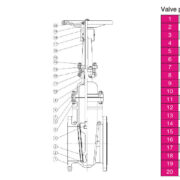
Cast Steel Valves: Strength, Reliability, and Performance in Industrial Applications
Cast Steel Valves: Strength, Reliability, and Performance in Industrial Applications
Cast steel valves represent the backbone of many industrial fluid control systems, offering exceptional durability and performance under demanding conditions. These robust components play a critical role in industries ranging from oil and gas to power generation, where reliability isn’t just preferred—it’s essential. This comprehensive guide explores how cast steel valves deliver the strength, reliability, and performance needed for the most challenging industrial environments.

What Are Cast Steel Valves? Understanding the Casting Process
Cast steel valves are industrial flow control devices manufactured through a metal casting process. This process involves pouring molten steel into precisely engineered molds to create valve bodies with specific shapes and properties. The casting method allows for complex geometries and thick-walled components that would be difficult or impossible to achieve through other manufacturing techniques.
The casting process begins with creating a pattern of the valve body, followed by forming a mold around this pattern. Once the mold is prepared, molten steel is poured in and allowed to solidify. After cooling, the mold is broken away, revealing the raw cast valve body. This component then undergoes machining, heat treatment, and finishing processes to create the final product.
Cast steel valves are distinguished from other valve types by their exceptional strength, pressure-handling capabilities, and resistance to thermal stress. These properties make them ideal for applications involving high pressure, extreme temperatures, or corrosive media.

Need Expert Guidance on Cast Steel Valves?
Our engineers can help you select the right valve for your specific application requirements.
The Inherent Strength of Cast Steel Valves
The exceptional strength of cast steel valves stems from both the material properties and manufacturing process. Cast steel offers superior mechanical characteristics that make these valves suitable for the most demanding industrial applications.
Mechanical Properties
Cast steel valves feature high tensile strength (typically 70,000-75,000 psi for WCB grade), excellent yield strength, and good impact resistance. These properties enable the valves to withstand significant mechanical stress without deformation or failure.
Pressure Ratings
These valves are available in pressure classes ranging from 150 PSI to 2500 PSI, making them suitable for both low and high-pressure systems. The robust construction allows them to maintain structural integrity even under fluctuating pressure conditions.
Temperature Resistance
Cast steel valves can operate effectively across a wide temperature range, typically from -20°F to 800°F for standard WCB material. This temperature versatility makes them ideal for steam systems, heated oil lines, and cryogenic applications.

| Material Grade | Tensile Strength (psi) | Yield Strength (psi) | Temperature Range (°F) | Common Applications |
| WCB | 70,000-75,000 | 36,000 | -20 to 800 | General purpose, steam, oil, gas |
| LCC | 70,000-75,000 | 36,000 | -50 to 650 | Low-temperature service |
| WC6 | 80,000-105,000 | 50,000 | -20 to 1100 | High-temperature, high-pressure |
| WC9 | 85,000-110,000 | 55,000 | -20 to 1100 | High-temperature, high-pressure |
Reliability Factors of Cast Steel Valves
The exceptional reliability of cast steel valves stems from several key factors that contribute to their long service life and consistent performance in demanding industrial environments.
Robust Construction
Cast steel valves feature thick-walled bodies that resist deformation under pressure and mechanical stress. The integral construction minimizes potential leak paths and weak points, enhancing overall reliability. Advanced casting techniques ensure uniform material density and structural integrity throughout the valve body.
Thermal Stress Resistance
These valves maintain their dimensional stability and functional integrity even when subjected to rapid temperature changes. The thermal expansion characteristics of cast steel allow the valves to handle thermal cycling without developing cracks or leaks. This property is particularly valuable in applications with frequent startup and shutdown cycles.

Corrosion and Erosion Resistance
Cast steel valves offer good resistance to many corrosive media, especially when properly specified with appropriate trim materials. The dense, uniform microstructure of quality cast steel provides inherent resistance to erosion from high-velocity flow or particulate-laden media. For enhanced corrosion resistance, special alloy grades or protective coatings can be applied.
Ready to Enhance Your System Reliability?
Explore our selection of high-quality cast steel valves engineered for maximum reliability in demanding applications.
Advantages of Cast Steel Valves
- Exceptional strength and pressure handling capability
- Excellent performance in extreme temperatures
- Long service life with minimal maintenance
- Good resistance to thermal shock
- Available in various configurations for different applications
- Cost-effective for large-diameter applications
Limitations to Consider
- Heavier than forged steel alternatives
- May require more inspection for critical applications
- Potential for porosity if casting quality is poor
- Longer lead times for specialized configurations
- Higher initial cost compared to cast iron options
Performance Characteristics and Applications
Cast steel valves deliver exceptional performance across a wide range of industrial applications. Their versatility and reliability make them the preferred choice for many critical fluid control systems.

Common Types of Cast Steel Valves

Gate Valves
Cast steel gate valves provide reliable on/off control with minimal flow restriction when fully open. They’re ideal for applications where infrequent operation and low pressure drop are required. Common in pipeline systems, water distribution, and steam applications.

Supape cu glob
Cast steel globe valves excel in throttling applications where precise flow control is needed. Their design allows for accurate regulation of flow rate and pressure. Frequently used in steam systems, feedwater regulation, and process control applications.

Supape de reținere
Cast steel check valves prevent backflow in piping systems, protecting equipment and maintaining process integrity. Available in swing, lift, and wafer designs to suit different application requirements. Essential in pump discharge lines and process systems.
Industry Applications
| Industry | Common Applications | Valve Types Used | Key Requirements |
| Oil & Gas | Pipelines, refineries, compressor stations, tank farms | Gate, ball, check, globe | High pressure, corrosion resistance, fire safety |
| Power Generation | Steam systems, feedwater, condensate, cooling water | Gate, globe, check | High temperature, thermal cycling, reliability |
| Chemical Processing | Process lines, reactor systems, storage facilities | Gate, globe, check, ball | Corrosion resistance, leak tightness, safety |
| Pulp & Paper | Steam systems, chemical processing, water treatment | Gate, globe, check | Reliability, abrasion resistance, maintainability |

Find the Perfect Cast Steel Valve for Your Application
Our technical team can help you select the optimal valve configuration based on your specific operating conditions.
Comparison with Alternative Valve Materials and Industry Standards
Cast Steel vs. Alternative Materials
| Characteristic | Cast Steel | Forged Steel | Fontă | Oţel inoxidabil |
| Pressure Capability | High (up to 2500 PSI) | Very High (up to 4500 PSI) | Limited (up to 250 PSI) | High (up to 2500 PSI) |
| Temperature Range | -20°F to 800°F (WCB) | -50°F to 1000°F | -20°F to 450°F | -150°F to 1000°F |
| Impact Resistance | Good | Excellent | Poor | Good to Excellent |
| Corrosion Resistance | Moderate | Moderate | Poor to Moderate | Excellent |
| Cost | Moderate | High | Low | High |
Key Industry Standards
Cast steel valves are manufactured according to stringent industry standards that ensure quality, safety, and interchangeability. Understanding these standards is essential for proper valve specification and application.
- ASTM A216 – Standard specification for steel castings suitable for fusion welding for high-temperature service
- API 600 – Specification for steel gate valves with flanged or butt-welding ends
- API 623 – Steel globe valves—flanged and butt-welding ends, bolted bonnets
- API 594 – Check valves: Flanged, lug, wafer, and butt-welding
- API 598 – Valve inspection and testing
- ASME B16.34 – Valves flanged, threaded, and welding end
- ASME B16.5 – Pipe flanges and flanged fittings
- ASME B16.10 – Face-to-face and end-to-end dimensions of valves
“Proper adherence to industry standards ensures that cast steel valves will deliver the expected performance and reliability in critical applications. These standards represent decades of industry experience and best practices.”
Need Technical Assistance with Valve Selection?
Our engineering team can help you navigate industry standards and select the right valve for your specific requirements.
Frequently Asked Questions About Cast Steel Valves
What is the difference between WCB and LCC cast steel?
WCB (ASTM A216 Grade WCB) is a standard carbon steel casting material suitable for temperatures from -20°F to 800°F. LCC (ASTM A352 Grade LCC) is a low-carbon steel casting material with enhanced low-temperature impact properties, suitable for service down to -50°F. LCC contains less carbon than WCB and undergoes additional heat treatment to improve its low-temperature toughness.
How do I select the right cast steel valve for my application?
Selection should consider several factors: operating pressure and temperature, media characteristics (corrosive, abrasive, etc.), flow requirements (on/off or throttling), frequency of operation, installation space constraints, and applicable industry standards. For critical applications, it’s advisable to consult with valve engineering specialists who can help match valve specifications to your specific requirements.
What maintenance do cast steel valves require?
Cast steel valves generally require periodic inspection of stem packing, body-bonnet gaskets, and seating surfaces. Stem lubrication should be performed according to manufacturer recommendations. For valves in critical service, a preventive maintenance program might include periodic valve cycling, leak testing, and non-destructive examination of pressure-containing components. Always follow the manufacturer’s maintenance guidelines for specific valve types.
Can cast steel valves be repaired or refurbished?
Yes, cast steel valves are often good candidates for repair and refurbishment. Common repair procedures include seat resurfacing, stem replacement, packing replacement, and body repairs using qualified welding procedures. For valves in critical service, repairs should be performed by qualified valve repair facilities that follow industry standards such as API 598 for testing after repair. Proper documentation of repairs is essential for maintaining valve integrity.
Conclusion: The Enduring Value of Cast Steel Valves
Cast steel valves continue to be a cornerstone of industrial fluid control systems due to their exceptional combination of strength, reliability, and performance. Their ability to withstand extreme pressures, temperatures, and operating conditions makes them indispensable in critical applications across numerous industries.
When properly specified, installed, and maintained, cast steel valves provide decades of dependable service, making them a cost-effective long-term investment despite their higher initial cost compared to some alternatives. As industrial processes evolve and operating conditions become more demanding, the inherent qualities of cast steel valves ensure they will remain a preferred choice for engineers and system designers worldwide.
By understanding the unique properties, applications, and standards associated with cast steel valves, industry professionals can make informed decisions that enhance system reliability, safety, and performance.