
API 598: Valve Inspection & Testing Standard (Complete Guide)
API 598 is the American Petroleum Institute (API) standard that defines inspection and testing requirements for industrial valves, including:
✔ Pressure tests (shell, seat, backseat)
✔ Leakage criteria (allowable rates)
✔ Test procedures (duration, media, pressure levels)
It applies to gate, globe, check, ball, and butterfly valves used in oil & gas, petrochemical, and other high-pressure industries.

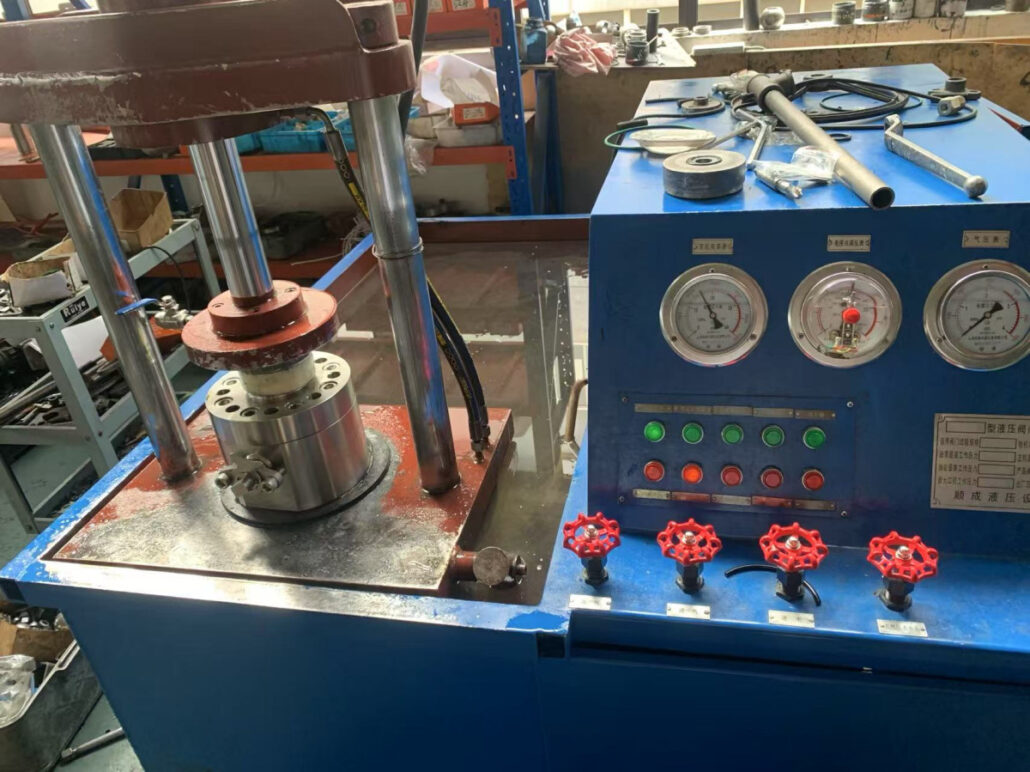
API598 Gate Valve Test,300LB API598 Gate Valve Test
🔹 Key Tests Under API 598
1. Shell Test (Pressure Integrity Test)
Purpose: Checks valve body & seal strength.
Test Medium: Water, air, or kerosene (non-shock test).
Pressure: 1.5x valve’s rated pressure (e.g., Class 300 valve tested at 750 psi).
Duration: At least 60 seconds for liquid, 30 seconds for gas.
2. Seat Test (Leakage Test)
Purpose: Ensures sealing performance (no leaks).
Test Medium: Water, air, or inert gas (nitrogen).
Pressure: 1.1x rated pressure (e.g., Class 150 valve tested at 165 psi).
Acceptable Leakage: Depends on valve type (see table below).
3. Backseat Test (Stem Seal Test – for Rising Stem Valves)
Purpose: Verifies stem sealing when fully open.
Test Pressure: Same as shell test.
Leakage Allowed: Zero leakage (must be bubble-tight).
4. High-Pressure Gas Test (Optional, for Severe Service)
Purpose: Extra validation for critical valves (e.g., hydrogen service).
Test Medium: Nitrogen or helium.
Pressure: Up to 1.5x rated pressure.

Ball Valves Covered by API 598
🔹 API 598 Leakage Allowance (Max Permitted Leak Rates)
| Valve Type | Test Medium | Max Leakage Allowed |
|---|---|---|
| Gate, Globe | Liquid (water) | 0 drops/min (bubble-tight) |
| Ball, Plug | Gas (air) | ≤ 20 bubbles/min (DN ≤ 100mm) |
| Check Valves | Liquid | 0.1 mL/min per inch of seat diameter |
| Butterfly Valves | Gas | ≤ 100 mL/min per inch of seat diameter |
(DN = Nominal Diameter in mm)
🔹 API 598 vs. Other Valve Testing Standards
| Standard | Scope | Key Difference |
|---|---|---|
| API 598 | General valve testing (oil & gas) | Stricter than MSS SP-61, less severe than API 6D |
| API 6D | Pipeline valves | Includes fire-safe testing (API 607/6FA) |
| ASME B16.34 | Pressure-temperature ratings | Does not define leakage rates |
| ISO 5208 | Global equivalent of API 598 | Similar but uses different leakage classes (A to G) |
🔹 When is API 598 Testing Required?
✅ New valve manufacturing (mandatory for API-certified valves)
✅ Repair/refurbishment (after maintenance or re-seating)
✅ Customer-requested validation (for critical applications)
🔹 How to Verify API 598 Compliance?
✔ Check the valve nameplate for API markings.
✔ Request test reports (shell/seat test results).
✔ Look for third-party inspection stamps (e.g., Lloyd’s, DNV).
Final Summary
API 598 ensures valves can handle rated pressure without leaking.
Shell test = strength check, seat test = sealing check.
Ball/plug valves allow minor gas leakage, while gate/globe valves must be bubble-tight.
API 598 vs. ISO 5208: Valve Testing Standards Compared
Both standards define valve testing procedures, but they differ in scope, leakage allowances, and global acceptance. Here’s a detailed breakdown:
🔹 Key Differences: API 598 vs. ISO 5208
Feature API 598 (American Petroleum Institute) ISO 5208 (International Org. for Standardization) Primary Use Oil & gas, petrochemical, high-pressure General industrial, water, European markets Leakage Classes No formal classes (fixed pass/fail) A to G (A = zero leakage, G = highest allowance) Test Pressures Shell: 1.5x rated pressure
Seat: 1.1xShell: 1.5x
Seat: 1.1x (similar)Acceptable Leakage Stricter for gas tests (e.g., ball valves: ≤20 bubbles/min) More flexible (Class D allows droplets) Backseat Test Required for rising-stem valves Optional Fire Testing Not included (separate: API 607/6FA) Not included Global Adoption Dominant in North America, Middle East Widely used in Europe, Asia 🔹 Leakage Rate Comparison
API 598 (Strict)
Ball/Plug Valves (Gas Test): ≤20 bubbles/min (for DN ≤100mm)
Gate/Globe Valves: Zero leakage (bubble-tight)
ISO 5208 (Class-Based)
Class A: Zero leakage (like API 598)
Class D: Allows droplets (common for general-purpose valves)
Class G: Highest leakage allowance (e.g., for wastewater valves)
🔹 How to Interpret a Valve Test Report
A typical API 598/ISO 5208 test report includes:
1. Valve Identification
Manufacturer, size, model, serial number
Pressure class (e.g., Class 300)
2. Test Conditions
Medium: Water, air, or nitrogen
Shell Test Pressure: (e.g., 750 psi for Class 300)
Seat Test Pressure: (e.g., 330 psi for Class 300)
3. Results
Test Type Pressure Held Duration Leakage Observed Pass/Fail Shell Test 750 psi 60 sec None ✅ Pass Seat Test 330 psi 60 sec 5 bubbles/min ✅ Pass (API 598 allows ≤20) 4. Certification Marks
API Monogram (if API 598 certified)
ISO 5208 Class (e.g., “ISO 5208 Class A”)
🔹 Which Standard Should You Use?
For oil/gas, refineries: API 598 (mandatory in many specs)
For water, HVAC, EU projects: ISO 5208 (often Class D)
Zero-leakage critical apps: Both allow it (API 598 or ISO Class A)
🔹 Need Help Deciding?
If your valve test report shows ISO Class D leakage, it may not meet API 598 (which is stricter).
For fire-safe valves, you’ll need API 607/6FA in addition to API 598.
Example Scenario:
A ball valve passes ISO 5208 Class D (allowing droplets) but fails API 598 (which requires ≤20 bubbles/min for gas tests).
Final Advice
✔ Check project specs – Many contracts explicitly require API 598.
✔ For zero leakage, demand ISO 5208 Class A or API 598 bubble-tight.
✔ When in doubt, request both tests for critical valves.How to Review a Valve Test Report (Step-by-Step Guide)
If you have a specific valve test report (API 598, ISO 5208, or other), share the following details, and I’ll help you interpret it:
1. Key Details to Check in a Valve Test Report
🔹 Valve Identification
Manufacturer name & valve model
Size (e.g., 2″ DN50)
Pressure class (e.g., Class 150, PN16)
Serial number & date of testing
🔹 Test Standards Applied
Is it API 598, ISO 5208, ASME B16.34, or another standard?
If ISO 5208, what leakage class (A, B, C, D, etc.)?
🔹 Test Parameters
Shell test pressure (usually 1.5x rated pressure)
Seat test pressure (usually 1.1x rated pressure)
Test medium (water, air, nitrogen, etc.)
Duration (e.g., 60 sec for shell, 30 sec for seat)
🔹 Leakage Results
Shell test leakage (should be zero for API 598)
Seat test leakage (compare against allowed rates)
Backseat test (if applicable, must be bubble-tight)
🔹 Certifications & Inspector Sign-Off
API Monogram (if API 598 certified)
Third-party inspection stamps (e.g., Lloyd’s, DNV, TÜV)
Inspector name & date
2. Example Test Report Breakdown
(You can replace this with your actual report data for analysis)
Test Type Pressure (psi) Duration Leakage Observed Requirement Pass/Fail? Shell Test 450 (1.5x Class 300) 60 sec None Zero leakage ✅ Pass Seat Test (Gas) 330 (1.1x Class 300) 30 sec 15 bubbles/min ≤20 bubbles/min (API 598) ✅ Pass Backseat Test 450 60 sec None Zero leakage ✅ Pass Conclusion: This valve meets API 598 standards since leakage is within limits.
3. Common Red Flags in Test Reports
❌ “N/A” or missing tests (e.g., no backseat test for a rising-stem valve)
❌ Leakage exceeds limits (e.g., seat test shows 30 bubbles/min when max is 20)
❌ No inspector sign-off (uncertified tests are unreliable)
❌ Pressure not held for full duration (e.g., test aborted at 45 sec instead of 60 sec)4. How to Share Your Report for Review
If you have a PDF, image, or data table, provide:
Valve type (ball, gate, etc.)
Size & pressure rating
Test standard used (API 598, ISO 5208, etc.)
Leakage results (if any)
*(Example: “2” SS316 ball valve, Class 150, API 598 test. Seat test showed 25 bubbles/min—is this acceptable?”)*
5. Need Immediate Help?
👉 For API 598: Ensure leakage is within Table 5 limits.
👉 For ISO 5208: Check if leakage matches the declared class (A-G).
👉 For fire-safe valves: Verify if API 607/6FA tests were done separately.